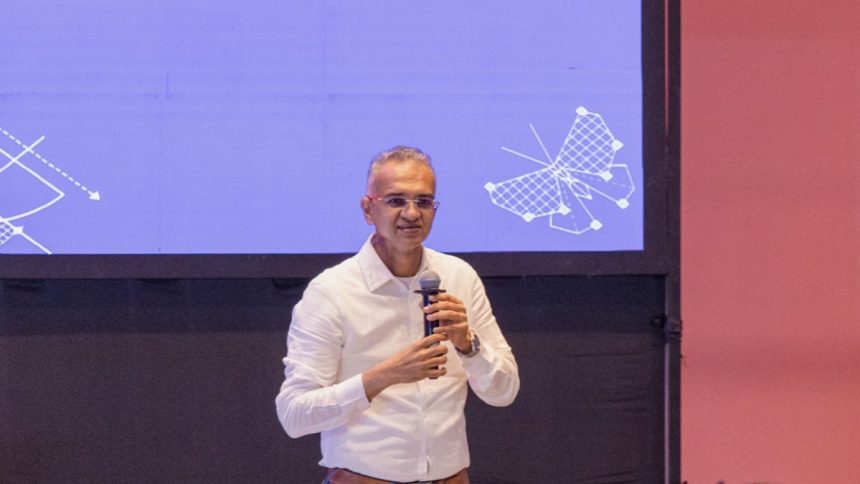
India’s Unified Payments Interface (UPI) has become the spine of one of the world’s largest digital economies, and the man who oversees it thinks artificial intelligence will define what comes next. Dilip Asbe, MD and CEO of the National Payments Corporation of India (NPCI), says AI will be woven into nearly every layer of the platform as it pushes from over 750 million daily transactions toward a target of more than a billion.
Speaking to TechCrunch at Mumbai Tech Week 2026 last month, Asbe laid out where AI fits in. It is not just about adding users — though he reckons the technology, alongside the central bank and government, could help onboard the next half a billion. It is also about defense.
- Fraud and “mule” detection to protect existing users
- Credit distribution for users and merchants with a digital footprint
- Voice and multilingual onboarding to lower the barrier to entry
Voice is a long-standing obsession in India’s tech scene, but Asbe is candid that it’s early days. NPCI launched a voice assistant-based interactive system back in 2023, and adoption hasn’t taken off yet. The models, he says, simply need to be more accurate before voice becomes a critical payment interface.
The global backdrop is hard to ignore. In the U.S., Coinbase and Robinhood now let agents trade on a user’s behalf, and OpenAI lets people feed account data into ChatGPT for financial advice. NPCI itself demoed agentic commerce and payments with Razorpay last year, though nothing has been rolled out widely. Asbe’s view is that India can absolutely adopt AI-powered finance — provided there’s a robust regulatory framework, strong user protection, and a way to audit the instructions and consent a user handed to an agent when something goes wrong.
One of his more interesting bets is on small, specialized models rather than giant general-purpose ones. “We believe that the models will differentiate from each other based on the data sets that are made available to them,” he said, arguing that India’s banks and fintechs sit on a rich data set and should build models that are “sharp, specific, and as deterministic as possible.” NPCI already runs one called FIMI, launched last year to handle user disputes; Asbe says it now serves over a million users cancelling mandates and resolving issues, and is scaling fast.
Then there’s the elephant in the room: competition. Walmart-owned PhonePe and Google Pay together hold over 80% of UPI’s market. NPCI’s plan to cap any single app at 30% market share is set to take effect on December 31, 2026 — a deadline that has already been deferred before. Asbe blames the concentration partly on the lack of a viable commercial model for newcomers, and notes that switching costs between apps are low.
NPCI’s own BHIM app, spun off in 2024 to spur competition, still sits at roughly 1% share. Asbe isn’t chasing a number there — he wants BHIM to be a sovereign, secure alternative. For global investors watching India’s fintech landscape, the regulatory weather matters as much as the technology.