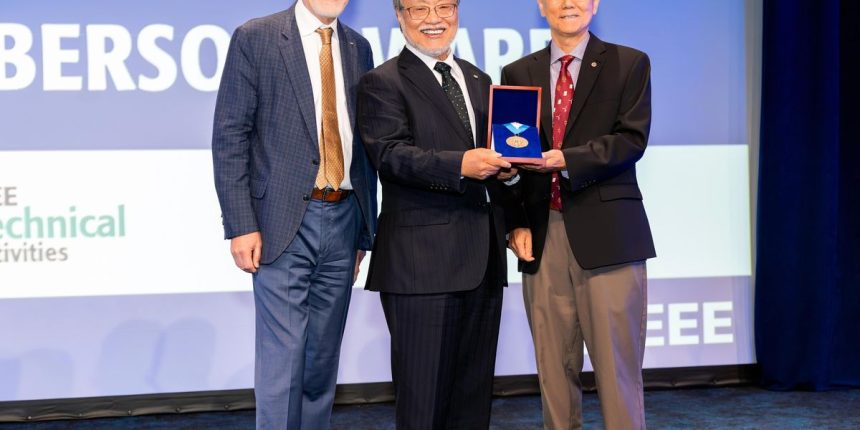
Some engineers build a single great machine. Toshio Fukuda built a whole way of thinking about them — and now IEEE has recognized his decades of work with its 2026 Richard M. Emberson Award, presented on 24 April 2026 for “distinguished service advancing the technical objectives of IEEE, especially in the area of robotics.”
For someone who has spent much of his career handing out honors, Fukuda finds the reversal amusing. As a former IEEE president and frequent master of ceremonies at the organization’s award events, he’s more used to reading names off the podium than hearing his own. “It’s very interesting to be on the receiving end,” he says.
The résumé behind that award is genuinely staggering: more than 2,000 research papers, several books, and pioneering contributions across biomedical robotics, industrial automation, micro-nano robotics, mechatronics, and AI-driven systems. In 2020 he became the first person of Asian descent to serve as IEEE president.
But it’s his hardware that gadget lovers should really care about. In 1985 Fukuda introduced CEBOTs — cellular robotic systems built from autonomous modules that snap together like interlocking bricks. Each cell carries a function; the system analyzes a task and assembles the right configuration on the fly. Cells connect, detach, and cooperate. Because a faulty unit can simply be pulled and replaced, the whole thing is inherently fault-tolerant and self-organizing.
Then there are the brachiation robots he helped develop — machines he affectionately calls “monkey robots” because they swing hand-over-hand using pendulum-like, gravity-driven locomotion. What began as an elegant motion study.
Fukuda’s path started with a very analog hobby: as a teenager he taught himself to build transistor radios and steam engines during summer breaks. That hands-on itch carried him from Waseda University to the University of Tokyo, a research stint at Yale, and eventually to Nagoya University, where he spent nearly 25 years and is now professor emeritus in micro-nano systems engineering.
He also launched IROS around 40 years ago. Now vice president of research at the Egypt-Japan University of Science and Technology in Alexandria, he remains a firm believer in an open field.