Hauling fuel out of Earth’s gravity well is one of the most expensive parts of any deep-space mission. Every kilogram of propellant a spacecraft carries from the launchpad adds weight, cost, and complexity. So NASA is chasing a smarter idea: what if a spacecraft could simply top up its tanks in orbit before charging off toward Mars and beyond?
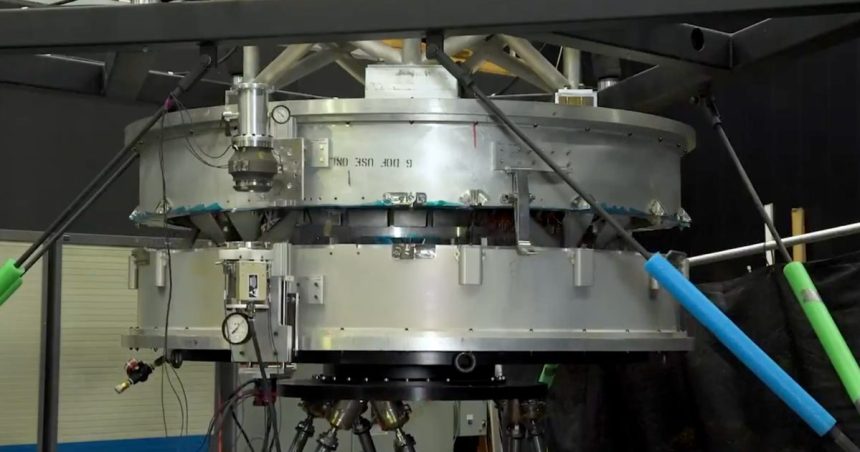
That vision took a small but meaningful step forward when engineers at NASA’s Marshall Space Flight Center in Huntsville, Alabama, finished testing a component called a cryocoupler, developed by American defense and technology company L3Harris.
So what is it? Think of the cryocoupler as the nozzle on a gas pump — except this one is built for spacecraft. It would let a rocket or deep-space probe dock with an orbiting fuel depot and take on cryogenic propellants such as liquid hydrogen and liquid oxygen, then disconnect and push on into the solar system.
The test itself was suitably brutal. On June 26, 2026, the team ran liquid nitrogen through the coupler at -321 degrees Fahrenheit, measuring how it performed at extreme cold in both connected and disconnected states. Engineers also threw misaligned docking simulations at it, since the device is designed to handle off-axis coupling rather than demanding a perfect, dead-center connection every time.
Two details make the cryocoupler especially promising. First, it is fully automated — no astronaut spacewalk required to hook things up. Second, it can attach and detach multiple times, which is exactly what a reusable orbital refueling station would need.
Before anyone gets carried away, this isn’t a solved problem. As cryocoupler project manager Travis Belcher put it, “in-orbit cryogenic refueling between two spacecraft has yet to be done and remains one of the toughest engineering challenges in spaceflight.” Cryogenic propellants are notoriously fussy — they boil off, they shift around in microgravity, and transferring them between two free-flying vehicles is a genuinely hard piece of engineering.
These are early-stage tests, too. Future evaluations will be tuned to specific conditions and missions rather than generic cold-flow trials. But the direction of travel is clear. If the engineering holds up, a future Mars-bound spacecraft could launch lighter and cheaper, then fill its tanks in Earth orbit instead of dragging every drop of fuel up from the ground.
It’s the kind of unglamorous component that rarely makes headlines, yet a working orbital nozzle could quietly reshape how humanity reaches the rest of the solar system.