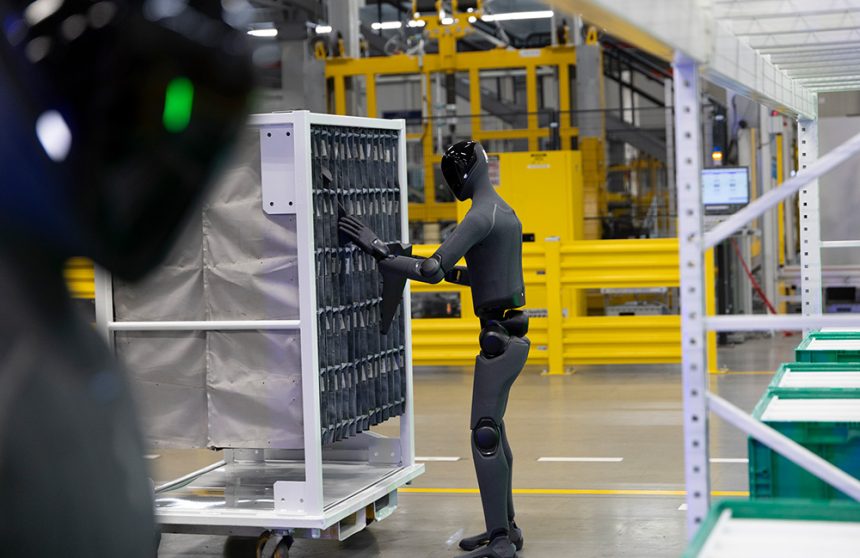
BMW Group has swapped in the next generation of factory humanoid. After its predecessor logged serious hours on the line, the Figure 03 from Figure AI has begun operations at BMW’s Plant Spartanburg in South Carolina, a deployment the automaker confirmed on May 13, 2026.
The move isn’t a leap of faith — it’s the payoff of a long trial. The earlier Figure 02 supported production of more than 30,000 BMW X3 vehicles over 11 months at the same facility. That’s a meaningful stint on a real assembly line, not a staged demo, and it gave both companies the data to justify graduating to the newer machine.
Figure 03 is a purpose-built industrial worker rather than a party trick. It stands 5’8″ (173 cm), weighs 61 kg (134 lbs), and can haul a payload of up to 20 kg. Battery runtime lands at 5 hours before a top-up — and it charges wirelessly, a smart touch for a robot expected to slot into a shift rotation without someone fumbling for a cable.
Where the design gets genuinely interesting is dexterity. The robot carries 44 degrees of freedom in total, with 16 of those packed into each hand. Its fingertips use tactile sensors sensitive enough to register forces as small as three grams — the kind of feather-light feedback you need to handle delicate parts without crushing them or fumbling them onto the floor.
Safety hasn’t been an afterthought either. Figure 03 uses soft components designed to make close-quarters work alongside human employees less risky. It also adds audio functions for speech-to-speech communication, so the machine can take spoken instruction and respond in kind rather than waiting for a tablet input.
Under the hood, the brains come from Helix, Figure’s proprietary vision-language-action model. That’s the framework that lets the robot see a task, understand a verbal command, and translate both into physical action — the connective tissue between perception and those 44 joints.
Figure 03 was first announced in October 2025, and BMW’s Spartanburg rollout marks one of its most visible enterprise engagements to date. Enterprise pricing is active for industrial customers, while a consumer-facing version is a different story: home availability is targeted for late 2026, with an unconfirmed target price of around $20,000. For now, though, the robot’s day job is building cars.
The bigger takeaway is that humanoids on factory floors are quietly shifting from proof-of-concept to standard equipment. When a carmaker moves from a pilot to a next-gen replacement, it’s a signal the technology has cleared its awkward first act.