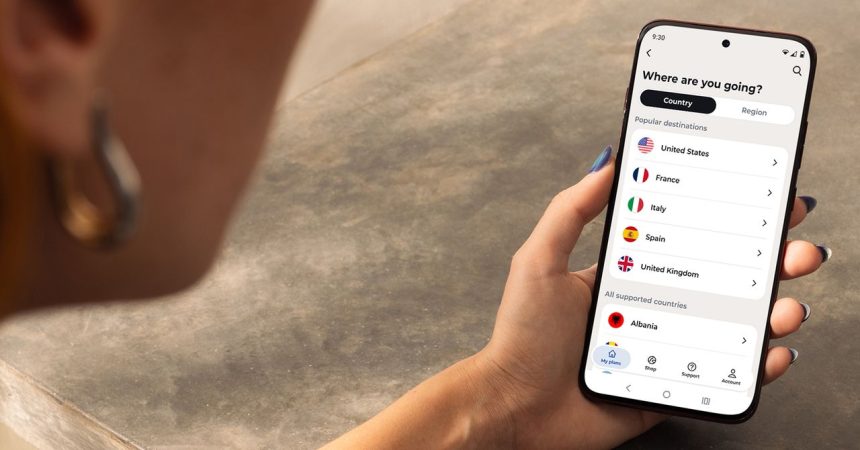
Travel eSIMs have quietly become one of the smartest tricks in a frequent flyer’s arsenal — no more hunting for a SIM kiosk at arrivals, no more eye-watering roaming bills. Motorola has now decided to cut out even that last bit of friction by building the whole experience directly into its phones.
The feature lives inside an app called Global Connect. For now it’s a download from the Google Play Store, but Motorola says it will come preinstalled on future devices. Crucially, it works with any Motorola handset that supports eSIM — and that’s the entire lineup, right down to the $180 2026 Moto G Play. This isn’t a flagship-only perk.
There’s a catch on geography, though. At launch, Global Connect is only usable in a handful of Latin American markets: Brazil, Mexico, Argentina, Peru, and Chile. Motorola says support in Germany, the UK, and the rest of Europe is arriving in the next several weeks. As for the US? The company had nothing to share yet.
The plumbing here comes from Gigs, a San Francisco firm that lets companies sell mobile data without wrestling with telecom contracts — the same outfit behind mobile plans from Klarna and Cash App. Motorola says it worked closely with Gigs so the whole thing feels like a Motorola-branded experience rather than a bolted-on third-party add-on.
Setting it up is straightforward: install the app, create a Gigs account, and you get 1 GB free with your first travel eSIM (a limited-time offer), after which you top up as needed. Sudhir Chadaga, Motorola’s VP for partnerships, says the rates are competitive — $3 for 1 GB over 30 days, up to $14 for 20 GB — with coverage in more than 160 countries. The same eSIM sticks with you across every trip.
As with most travel eSIMs, this is data-only — no calls or texts from your own number. In practice, that’s rarely a dealbreaker given how universal WhatsApp is in tourist hotspots.
Motorola claims this is the first time a major smartphone maker has embedded a travel eSIM function natively. That’s not quite airtight history — Xiaomi offered a similar virtual travel SIM back in 2015 before killing it off — but the timing is sharper now that eSIM-capable phones are everywhere.
The strategic logic is clear. As Counterpoint Research analyst Siddhant Cally puts it, the market is saturated with thousands of options from Airalo to Nomad to Holafly, so the real battle is over who becomes a traveler’s first touchpoint. And, in his words, “nothing gets closer to the first touchpoint than a built-in stock app.”
Whether the built-in convenience is enough to keep bargain hunters from shopping around for a cheaper plan is another question entirely. Cally calls the Gigs partnership “disruptive and novel” — but not the kind of thing that’ll make anyone switch phones for it.