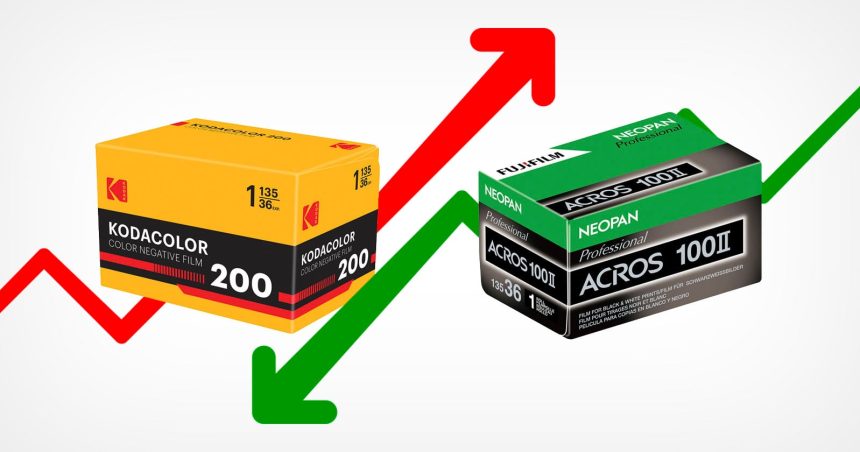
Ask anyone who still loads a canister into their camera and they’ll tell you the same thing: film keeps getting more expensive. According to a fresh report from Analog Cafe, that gut feeling doesn’t quite match the numbers.
The Film Price Watch report tracked 37 film products sold worldwide, averaging prices from 13 major retailers. The headline figure? Film rose just 2.5% on average over the last six months — and the six months before that saw no change at all. In other words, film pricing in 2026 has been remarkably stable.
To put that in perspective, Analog Cafe notes that a healthy annual inflation rate hovers around 3%. A 2.5% bump over half a year sits comfortably within that band, which means film is essentially keeping pace with the broader economy rather than outrunning it. In the United States, where inflation hit 4% in 2025, that arguably makes film one of the better-behaved goods on the shelf.
The report also punctures a bit of nostalgia. A roll of Kodak Gold 100 (24 exp.) that sold for $4.60 in the 1990s would cost $11.40 today once inflation is factored in. Compare that to Kodak Gold 200 in 36 exp. — 12 more frames — which averages $10.34 in 2026. On a per-frame basis, modern shooters are getting a genuinely better deal than their film-loving parents did.
Of course, no dataset is without its troublemakers. A handful of stocks climbed noticeably this year:
- Kodak Kodacolor 200 — up 10.5%
- Ilford XP2 Super 400 — up 10.4%
- Ilford FP4 Plus 125 — up 9.2%
Kentmere Pan 200, Lomography Lomochrome Metropolis, and Ilford HP5 Plus 400 also crept upward.
But the ledger swings both ways. Several films actually got cheaper:
- Kodak Ektapan (T-Max) 400 — down 4.9%
- Ilford Delta Professional 3200 — down 3.5%
- Kodak UltraMax 400 — down 2.6%
Fujifilm Neopan Acros 100, Lomography Lomochrome Purple, and Harman Phoenix 200 also slid downward.
The broader takeaway is refreshingly undramatic: film is not spiraling out of reach — at least not yet. That qualifier matters, given the industry’s recent history of price hikes and discontinued lines. But for now, if you’ve been putting off that box of 35mm because you assumed prices had gone haywire, the data suggests you can breathe a little easier.