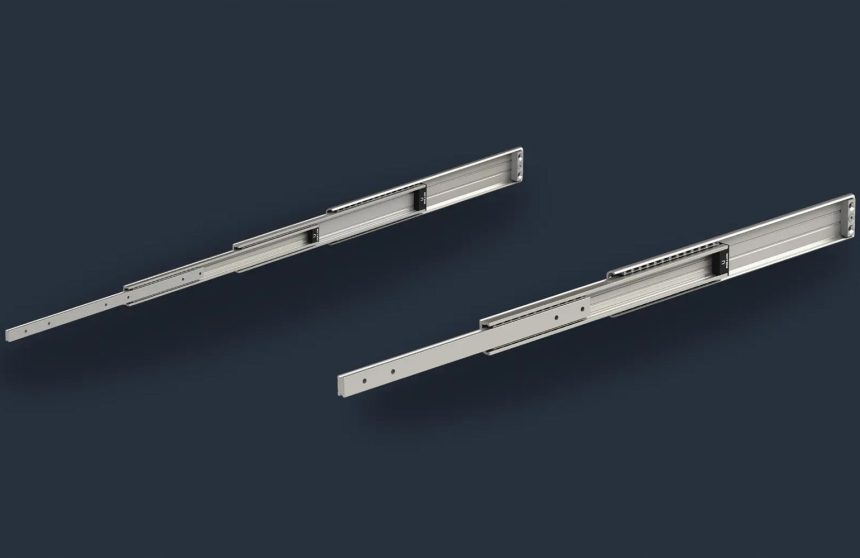
Pulling open a heavy telescopic rail is one of those small mechanical annoyances that industrial designers have quietly tolerated for decades. Rollon, a global specialist in linear motion, has decided it doesn’t have to stay that way — and its answer is a set of embedded magnets that take charge of how the rail moves.
On July 7, 2026 the company launched two new members of its magnet-equipped lineup: the HVC-MG and the H1C-MG. The HVC-MG comes in sizes 54 and 68, while the H1C-MG is offered in size 68. In both, integrated magnets impose a defined, predictable motion on the rail elements as they extend. The practical upshot is smoother, more controlled travel and — crucially for anyone who has wrestled with a stiff drawer mechanism — noticeably less force needed to open the rail.
The other half of the story is hidden inside the ball cage. Rollon reduced the pitch, packing more balls into the same cage length. That translates into higher load capacity without any change to the rail’s overall dimensions, so engineers can drop the upgraded parts into existing designs and get more headroom for free.
These two are not lone experiments. They follow the HGT-MG, announced back on November 17, 2025, which introduced the same philosophy in sizes 60 and 80. That rail uses a newly engineered ball cage with reduced pitch plus end blocks housing internal magnets, which align and synchronize the elements during extension to cut the opening force. It also features a damped end stroke — a quieter finish to each movement that reduces mechanical stress and, Rollon says, extends service life.
Taken together, the family points in one clear direction. According to Rollon, the magnets deliver:
- Improved load management, thanks to the denser ball arrangement
- Smoother extension, with the magnets guiding a defined motion path
- Increased durability, even under intensive operating conditions
It’s a subtle bit of engineering, but the appeal is easy to grasp. Magnetic synchronization means the rail elements move together rather than fighting each other, which is exactly the kind of refinement that pays off in demanding, repetitive-cycle applications — think transport interiors, machinery access panels, and industrial cabinets that get opened thousands of times.
Fittingly, transport is where these rails will make their public bow. Both the HVC-MG and H1C-MG are set to be displayed for the first time at InnoTrans in Berlin, Germany, running September 22–25. It’s a logical stage: rail vehicles are full of heavy access panels and equipment drawers where controlled, low-effort extension and long-term reliability matter more than almost anywhere else.
No pricing has been disclosed, but for a product line aimed squarely at industrial integrators, the more telling numbers are the ones about load and longevity — and those are the ones Rollon is betting on.