Ten years, ten countries, and a single uncomfortable thesis: there is no such thing as pure cocaine. That’s the conclusion Danish photographer Mads Nissen reaches in Sangre Blanca — “White Blood” — a reportage book that follows the world’s most lucrative black market from Colombian coca fields to European dancefloors.
Shot between 2016 and 2025, the project is being billed as the most significant photojournalistic study of the cocaine industry to date. And it earns that claim by refusing to flinch. Nissen tracks the drug along its entire supply chain, framing the same product as two wildly different things depending on where you stand: a weekend stimulant for many Europeans and North Americans, a source of bloodshed and corruption for the Latin American communities that produce it.
The numbers underline the futility he documents. More than 50 years into the War on Drugs, both production and consumption have never been higher. Colombia remains the epicentre, responsible for roughly two-thirds of global cocaine output according to the UNODC — and bearing a disproportionate share of the violence that comes with it.
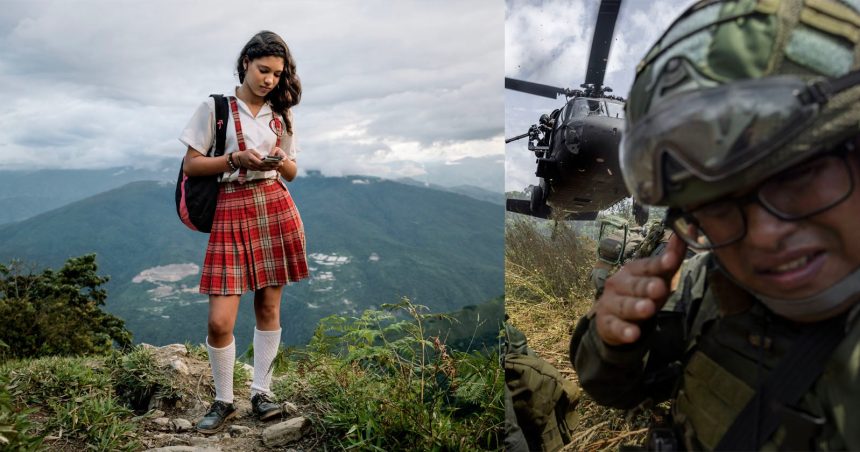
Nissen’s images map that violence with unsettling intimacy. A 53-year-old laborer named Ovidio hauls sacks of coca leaves through the Cauca mountains for about $25 a day. A child naps on the floor of her father’s makeshift laboratory while the chemistry continues around her — a process that swallows roughly 700 kilos of coca leaves, plus cement, ammonium, sulfuric acid, sodium permanganate, caustic soda and gasoline, to isolate a single kilo of coca paste.
Elsewhere, Colombia’s elite anti-narcotics unit Los Comandos Jungla rappels into the jungle with fifteen minutes to seize and destroy a second-phase laboratory capable of producing up to 500 kilos a week, all while bracing for a counterattack from ELN guerrillas. The human cost is never abstract: there’s Gerson Acosta, a 35-year-old Indigenous leader shot outside his home in 2017, and 25-year-old Jesús Bautista, who lost a leg and the sight in one eye to a landmine.
The book widens its lens beyond Colombia into Mexico’s cartel territories and onto European nightlife, where buyers now order cocaine online and receive delivery within an hour — Europe having become the world’s largest market.
“I came to realize that there is no such thing as pure cocaine,” Nissen says. “It is always soaked in blood.”
The publication is a collaboration with Colombian artist Juan Arreaza, whose oil paintings add a second visual voice. Drawing on nightlife in Europe and the United States, Arreaza paints historical figures who shaped the drug trade — using chemicals sourced directly from cocaine laboratories as his medium.
Sangre Blanca is published by Gost.