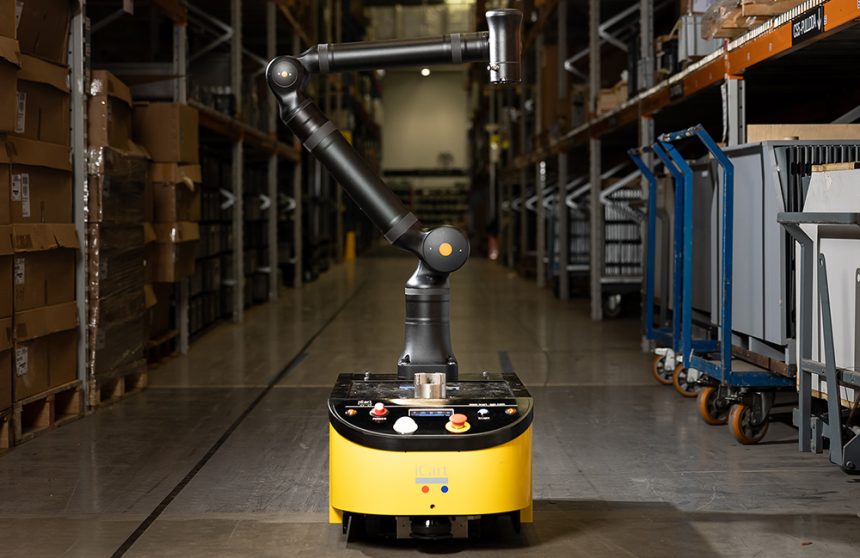
Warehouses are increasingly run by machines that move and machines that grasp — and for years those were two separate worlds. Mobile robots roamed the floor, robotic arms stayed bolted to a bench, and getting them to cooperate was somebody else’s integration headache. The appetite for closing that gap is no accident: collaborative robots saw their usage climb tenfold between 2018 and 2025, according to figures cited by Kassow.
The LIMO Cobot, a joint platform from Elephant Robotics and AgileX Robotics, is a tidy answer to the question of what happens when you simply put one on top of the other. It pairs a six-axis collaborative arm with a wheeled mobile base, turning a stationary manipulator into something that can drive itself to wherever the work is.
The arm is the myCobot 280 M5, a featherweight at just 850g. It handles a 250g payload across a 280mm effective working radius — modest numbers, but exactly the scale you want for education, competitions and training rather than heavy-duty palletising.
The interesting half is underneath. The LIMO PRO base runs on four hub motors and, crucially, offers four switchable steering modes:
- Ackermann steering for car-like motion
- Four-wheel differential steering
- Tracked steering
- Omni-directional steering for sideways and on-the-spot moves
That flexibility lets a single chassis impersonate several different robot types, which is gold in a teaching or research setting where you’d otherwise need a shelf full of distinct platforms.
The sensor and compute stack is genuinely serious for a machine at this price. An NVIDIA Jetson Orin Nano does the thinking, fed by an EAI T-mini Pro LiDAR and an Orbbec Dabai depth camera, with an integrated IMU keeping track of orientation. It’s the kind of perception hardware you’d expect on something far more expensive and far less willing to let students poke at its code.
And poke they can. The LIMO Cobot supports ROS 2 out of the box, with the full toolbox developers actually use: RViz for visualisation, Nav2 for autonomous navigation and Gazebo for simulation. That means you can map an environment, plan a path, send the arm to a target and rehearse the whole thing virtually before the wheels ever turn.
Pricing starts at US$5,280, which positions it squarely as a learning and prototyping tool rather than a production-line workhorse. For universities, robotics clubs and labs that want to teach mobile manipulation as one integrated discipline — perception, navigation and grasping in a single body — that’s a reasonable entry fee.
The broader point is that compact cobot integration isn’t just a neat demo. As autonomous mobile robots spread through warehouses, the ones that can also act on their surroundings, not merely shuttle between them, are the ones worth watching. The LIMO Cobot is a small, affordable preview of that future.