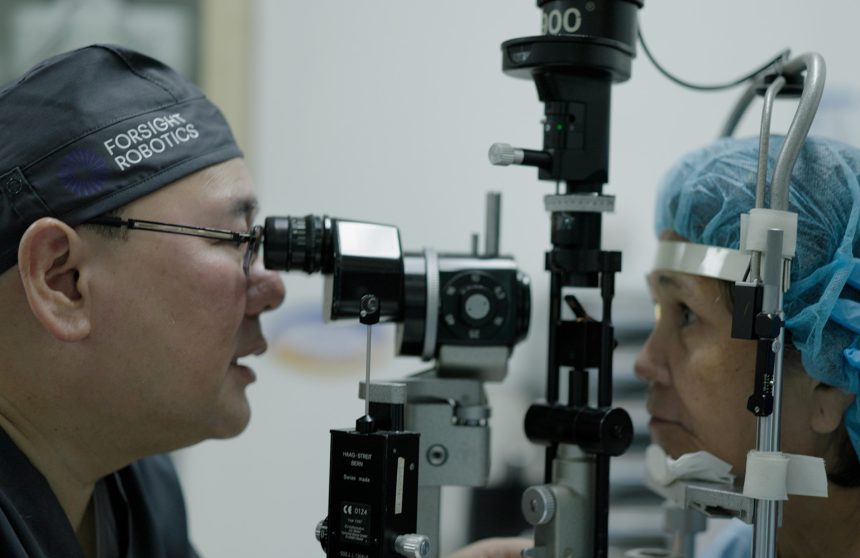
Cataract surgery is one of the most common procedures on the planet, yet it remains stubbornly dependent on a steady human hand and years of accumulated muscle memory. ForSight Robotics wants to change that equation — not by replacing the surgeon, but by giving them a machine that can navigate the eye with a precision no wrist can match.
The company’s JASPER Platform — short for Joint Aligned System for Precise Eye Robotics — is built to assist with cataract operations while keeping decision-making firmly in the surgeon’s control. Think of it less as an autopilot and more as a co-pilot with impossibly fine motor skills.
What makes JASPER interesting under the hood is the combination it leans on:
- AI-based algorithms that help plan and guide movements inside the eye
- Advanced computer vision for real-time navigation of a structure barely larger than a marble
- Miniaturized mechanics capable of reaching any point within the human eye
That reach is the headline. According to ForSight, the platform can navigate complex angles and access both the anterior and posterior segments of the eye. In practice, that means JASPER isn’t being designed purely for cataracts — the same architecture leaves the door open for future glaucoma and retinal procedures, two areas where surgical margins are unforgiving and where robotic steadiness could pay off enormously.
The project crossed a genuine milestone on April 7, 2026, when ForSight completed its first-in-human procedure. In the robotics world, plenty of platforms look impressive in a lab demo and never make it near a patient, so reaching the human trial stage is a meaningful signal that the mechanics and the software actually hold up under real clinical pressure.
That said, JASPER is still very much a work in progress. The platform remains under design and development, and it is not yet approved for commercial use. ForSight is now advancing toward clinical validation and regulatory submissions — the long, deliberately cautious path that any device touching the eye has to walk before it lands in an operating room near you.
There’s no price, and there won’t be one until the regulators have their say. But the ambition is clear enough. Cataract surgery is high-volume, high-stakes, and heavily reliant on scarce surgical expertise, particularly in parts of the world where trained ophthalmic surgeons are thin on the ground. A robotic system that standardizes the hardest parts of the operation — while still letting a human make the calls — could widen access dramatically.
For now, JASPER sits in that fascinating gap between proof-of-concept and product: technically real, clinically demonstrated once, and still years of paperwork away from your local clinic. Worth watching closely.