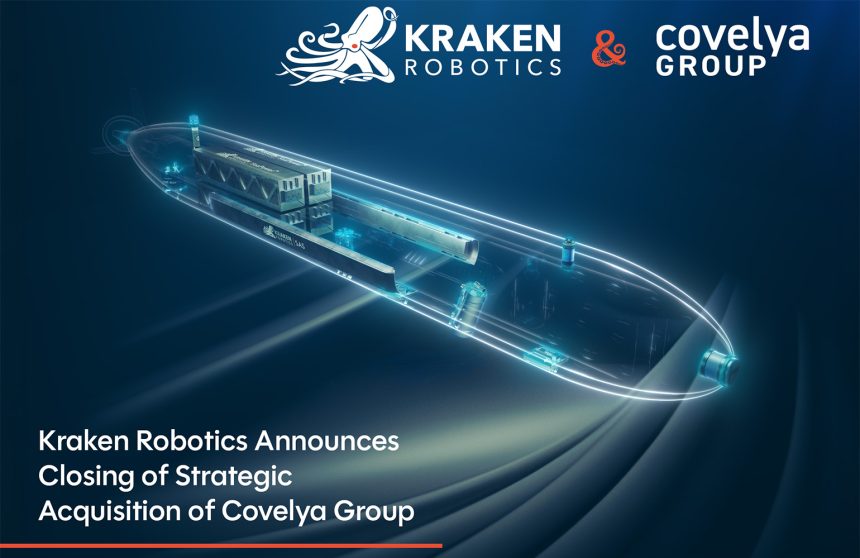
Ocean-tech specialist Kraken Robotics has just made its biggest move yet. On July 2, 2026, the company closed its acquisition of Covelya Group Limited in a deal worth roughly US$615 million, folding one of the more ambitious subsea technology outfits into its expanding portfolio.
For anyone who follows the underwater robotics scene, this is a notable consolidation. Kraken has built its name on sonar, subsea batteries, and autonomous underwater vehicles — the kind of gear that maps seabeds, inspects pipelines, and hunts for objects lost in the deep. Covelya brings complementary capabilities that broaden that reach, and the strategic logic is refreshingly clear: more products, more markets.
According to Kraken, the deal expands its product offerings and total addressable market in subsea technology. In plainer terms, the company isn’t just buying revenue — it’s buying room to grow. The subsea sector is having a moment, driven by offshore energy, defense contracts, and the surge in seabed infrastructure like data cables and monitoring systems. Owning more of the toolchain, from sensing hardware to full underwater platforms, positions Kraken to bid on bigger, more integrated projects.
Acquisitions of this scale rarely happen by accident. A US$615 million transaction signals confidence that demand for autonomous subsea systems is climbing fast enough to justify the spend. It also reflects a broader trend in the robotics world, where the deep ocean is increasingly treated as the next serious operating environment — less glamorous than space, arguably harder to work in, and full of commercial upside.
What makes Kraken interesting is that it sits at the intersection of several hard engineering problems at once:
- Sensing: high-resolution sonar and imaging that has to function where light and radio signals simply don’t travel far.
- Power: pressure-tolerant subsea batteries that keep vehicles running through long missions.
- Autonomy: vehicles that navigate and make decisions without a tether to the surface.
Bringing Covelya inside sharpens that stack. The combined entity should be able to offer customers a more complete package rather than a collection of point solutions — and in a market where reliability at depth is everything, that kind of integration matters.
The move also raises Kraken’s profile against a field of established marine-tech and defense players. Scale buys credibility with the large institutional and government buyers who dominate subsea procurement, and it gives Kraken a stronger hand when competing for multi-year contracts.
For now, the headline is simple: Kraken Robotics has significantly enlarged both its capabilities and its ambitions in a single stroke. The real test comes next — turning a US$615 million bet into a genuinely unified subsea business. If the integration goes well, the deep ocean just got a little more crowded with serious contenders, and Kraken has firmly staked its claim among them.