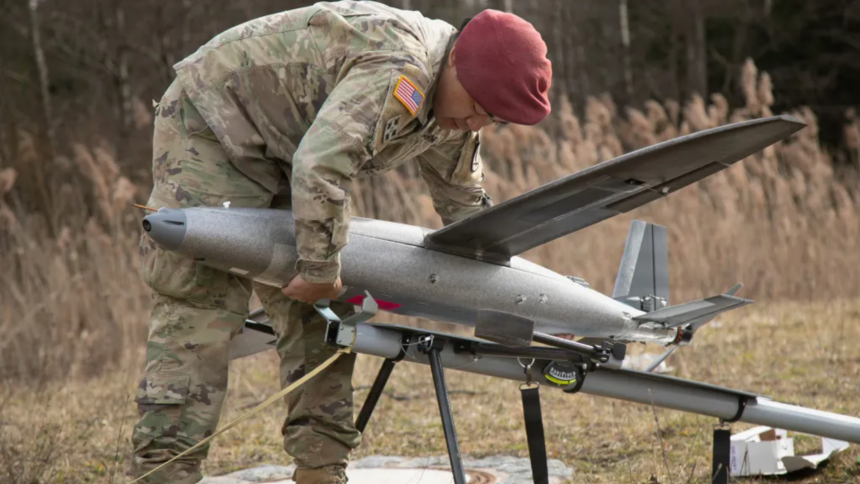
Here is a scenario that reads less like a NATO field manual and more like a multiplayer match: during the Combined Resolve exercise in Germany in 2026, Ukrainian drone operators dismantled a US armored force so fast that instructors had to respawn the destroyed equipment just to keep the training going.
The Ukrainians in question came from the 412th Regiment of Unmanned Systems Forces, better known by its call sign Nemesis. On the other side stood roughly 3,500 US service members, drawn mostly from the 3rd Armored Brigade Combat Team of the 1st Cavalry Division — a heavy formation of exactly the kind that has defined American land power for decades.
The mismatch was not about tonnage. It was about what happens when cheap, disposable flying machines meet expensive, hard-to-hide armor. The Nemesis operators brought the full toolkit forged over years of real combat:
- Reconnaissance drones to find and fix targets before they knew they were being watched;
- Explosive-dropping drones that turn a quadcopter into precision-guided airborne artillery;
- First-person-view (FPV) drones — the kamikaze racers that dive straight into a hull, a track, or an open hatch.
The result was decisive enough that the simulated battle effectively broke the exercise’s pacing. Vehicles that would have been smoldering wrecks in a live engagement had to be digitally or administratively brought back so the American troops could continue learning. In gaming terms, the armor kept dying faster than the scenario could reset it.
That embarrassment is, in fact, the entire point. Combined Resolve is a teaching environment, and losing to Nemesis is arguably more valuable to the US Army than winning. Ukrainian forces have spent the war rewriting the rules of the modern battlefield in real time, discovering exactly how thin the survival window becomes when a soldier or a tank steps into the line of sight of a swarm of small drones.
For a conventional armored brigade, the lessons are uncomfortable but concrete: massing vehicles is now a liability, electronic warfare and counter-drone systems are no longer optional add-ons, and the old assumption that heavy metal dominates the open field simply does not hold when the sky is full of hunters costing a few hundred dollars each.
What makes the exercise notable is the reversal of roles. For years, allies came to American ranges to learn from the US military. This time, the veterans of the world’s most drone-saturated conflict were the instructors, and a US brigade was the class. The takeaway for anyone watching the future of warfare — and the gadgets that will define it — is blunt: the next great arms race is being fought at the scale of a hobbyist’s quadcopter, and the people who understand it best learned the hard way.