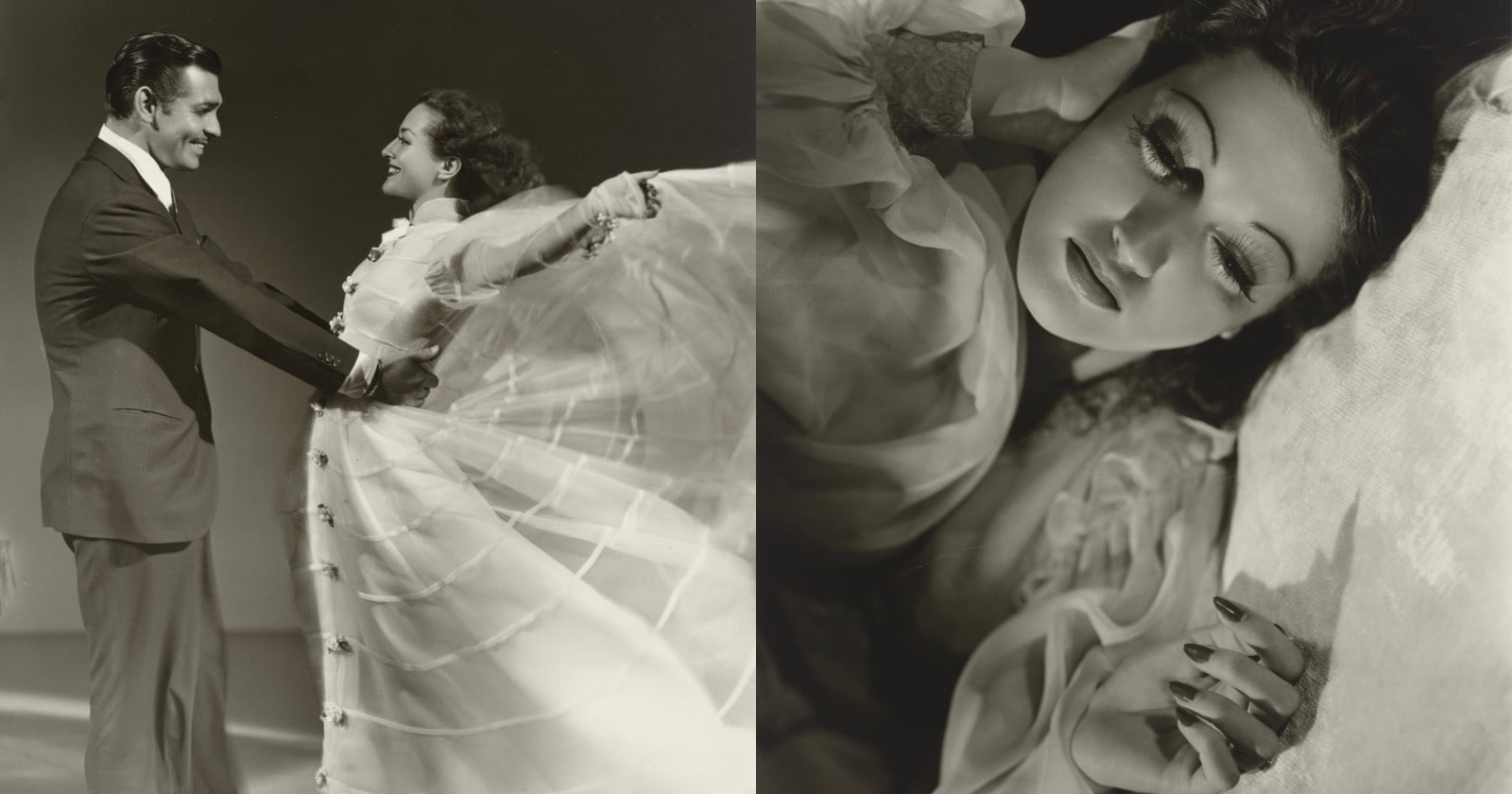
Long before ring lights, beauty filters and AI retouching, a single photographer working with 8 x 10 cameras, hard light and a retoucher’s pencil defined what “Hollywood glamor” looks like. That photographer was George Hurrell, and the Smithsonian’s National Portrait Gallery in Washington, D.C., has given him a second run in the spotlight.
Star Power: Photographs from Hollywood’s Golden Age by George Hurrell (A Sequel) opened on February 13, 2026 and runs through January 10, 2027. It is the second installation of the show. The first iteration was on view from March 1, 2024 to January 25, 2026. The exhibition is curated by Ann Shumard, the museum’s senior curator of photographs.
Twenty prints from a collection of 70
The encore swaps in a fresh set of 20 vintage photographs, drawn from the Portrait Gallery’s holding of 70 Hurrell portraits. Most are gelatin silver prints dated from 1930 to 1937. The sitters read like a studio-era casting sheet:
- Joan Crawford and Clark Gable, photographed together in 1936
- Greta Garbo (1930) and Jean Harlow (1934)
- Marlene Dietrich, Myrna Loy, Dorothy Lamour, Barbara Stanwyck and Douglas Fairbanks Jr., all c. 1935
- Mary Pickford with Charles “Buddy” Rogers (1937)
- Also Constance Bennett, William Powell, Basil Rathbone and Rosalind Russell
How the look was built
Hurrell’s method was a craft rather than a happy accident. Careful posing, inventive lighting and meticulous retouching turned stars into idealized, larger-than-life figures. The prints then went out to theaters, fan magazines and the public, so his style became the public face of the studios. “They were truly glamorous people,” he once said, “and that was the image I wanted to portray.”
Born in Covington, Kentucky, in 1904 and raised in Cincinnati, Hurrell first trained as a painter at the Art Institute of Chicago. He picked up a camera to document his canvases, and photography took over while he was living at a California artists’ colony in the 1920s. At 25 he joined MGM’s publicity department and quickly became the studio’s principal portraitist. In 1933 he left to open his own studio on Sunset Boulevard, where he kept shooting MGM talent alongside stars from rival studios. He closed it in 1938, worked briefly for Warner Bros. and Columbia Pictures, then served with a military film production unit during World War II.
When the big cameras went away
After the war, candid pictures made with portable small-format cameras pushed aside the slow, large-format studio portrait. Hurrell put it bluntly: “When we stopped using those 8 x 10 cameras, the glamor was gone.” He returned to Hollywood in the mid-1950s as a still photographer on film sets. Interest in his work revived in the 1980s, and a then little-known Sharon Stone was among his later clients. He died in Los Angeles in 1992 at age 87. His prints are held by the J. Paul Getty Museum, the Museum of Modern Art and the Library of Congress.
For photographers raised on mirrorless autofocus and computational sharpening, the show is a useful reminder: light, pose and patience can still beat any processor.