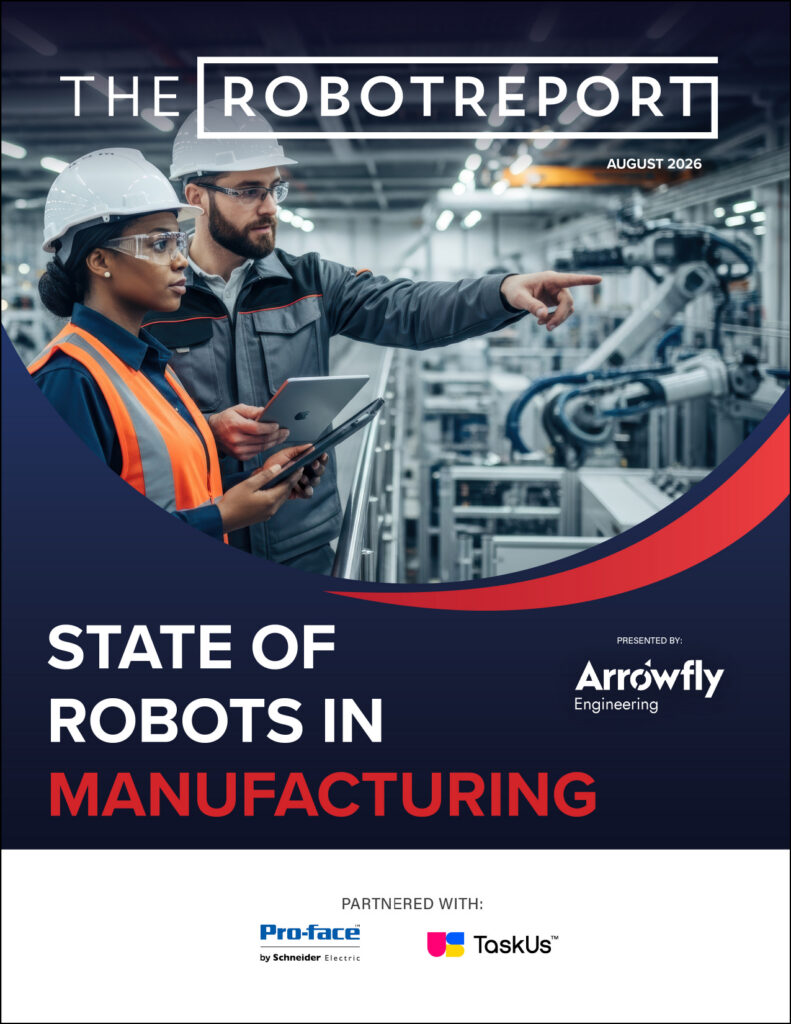
Picture a factory robot and you probably see a big orange arm welding car bodies behind a safety fence, repeating the same motion millions of times. That picture is going out of date. State of Robots in Manufacturing, a free downloadable report The Robot Report published on September 29, 2026, argues that industrial automation has moved past rigid, pre-programmed arms toward a broader, more flexible set of machines. The main driver is the labor shortage that manufacturers across many sectors are facing.
The report is sponsored by Pro-Face and TaskUS. It pulls together technology advances, use cases and industry trends into one overview for anyone following factory automation.
The numbers behind the shift
The Robot Report builds its case on data from the two big industry bodies:
- According to the International Federation of Robotics, industrial robot installations doubled in the decade ending 2024.
- Robot density, meaning robots per 10,000 workers, is rising worldwide. The leaders are South Korea, Singapore, Germany and Japan. In the IFR’s World Robotics 2025 report (2024 data), those countries stood at 1,220, 818, 449 and 446 units per 10,000 employees respectively.
- According to the Association for Advancing Automation (A3), robot order value grew 6.6% year over year in the first half of 2026. Orders from outside the automotive sector made up for the slowdown among carmakers.
A3’s own figures show how deep that rotation goes. North American companies ordered 17,995 robots worth $1.166 billion in the first half of 2026, 2.0% more units than a year earlier. Orders from automotive OEMs fell 25%. Unit orders from semiconductors, electronics and photonics rose 35%, and life sciences, pharmaceuticals and biomedical rose 32%. Collaborative robots came to 2,774 units valued at $114 million, or 15.4% of all units ordered.
What the report covers
Beyond the statistics, the editors look at several themes that are shaping factory automation:
- how robots can support scarce workers rather than simply replace them;
- advances in sensing and manipulation, which let robots handle less structured tasks;
- automation’s role in reshoring production and in national security;
- recent industry collaborations and deployments;
- the potential of humanoid robots and AI on the factory floor.
The report also maps where robots are actually earning their keep: material handling, assembly, welding, machine tending and finishing. The industries covered include electronics, metals, food and beverage, and pharmaceuticals.
Why it matters
For years, automotive plants drove robot demand, so a delayed model changeover could drag down a whole quarter’s order figures. The data in this report points to a steadier base: chip fabs, drug makers and food processors are now buying robots too, often smaller and collaborative ones. With humanoids and AI-driven manipulation now on the agenda, the question has shifted from whether a task can be automated to how quickly a robot can be redeployed to the next job. The Robot Report’s overview is a compact way to see where that shift stands as of September 2026.