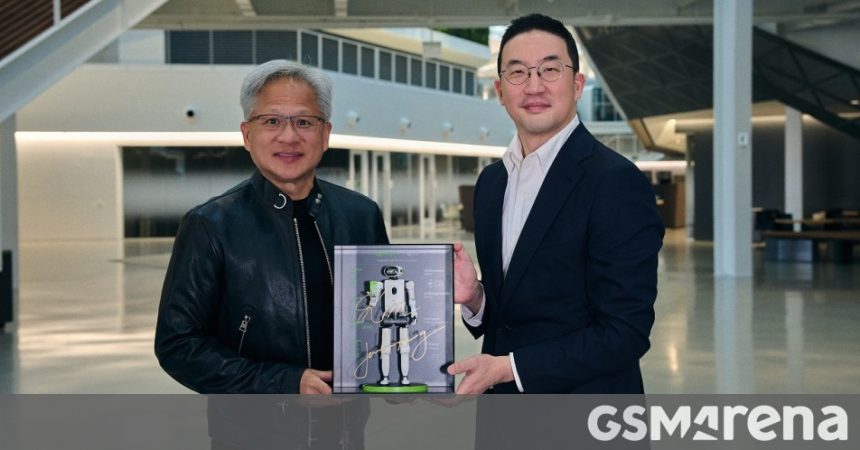
Two hardware heavyweights just tied their AI ambitions together. LG Corp. chairman and CEO Kwang Mo Koo made the trip to Nvidia’s Santa Clara headquarters to sign a memorandum of understanding with Jensen Huang, and the roadmap that came out of it spans everything from bipedal robots to the compute stack inside future cars.
The centerpiece is a humanoid robot that LG plans to unveil in the first quarter of 2027. It’s a proper bipedal design, and rather than reinventing the wheel on the software side, LG is leaning on Nvidia’s tooling: the Isaac GR00T open reasoning humanoid foundation model handles the thinking, while a Jetson Thor module does the on-board number crunching. That Jetson Thor is no slouch — it delivers 2,070 TFLOPs of compute, which is the kind of headroom a walking machine needs to perceive and react in real time.
What makes this more than a badge-swap is how much of the robot comes from inside LG’s own group. The actuators are supplied by LG Electronics, the sensors by LG Innotek, and the batteries by LG Energy Solution. In other words, LG isn’t just buying an Nvidia brain and bolting it onto someone else’s body — it’s assembling nearly the entire physical platform in-house and letting Nvidia handle the intelligence.
Before the humanoid arrives, LG has a more grounded robot ready to earn its keep. The wheeled LG CLOiD is set to go to work on the company’s washing machine manufacturing line in Tennessee later this year. It’s a telling choice: rather than a showroom demo, LG is dropping a robot straight into a live factory, which is exactly where the practical value of autonomous machines tends to show up first.
The partnership also reaches into the car. LG and Nvidia are building a high-performance computing platform for what the companies call next-generation AI-defined vehicles (AIDVs). The recipe combines Nvidia’s Drive Hyperion with LG’s in-vehicle infotainment (IVI) and software know-how. LG brings years of cabin-facing experience, Nvidia brings the automotive-grade autonomy platform, and together they’re aiming at the compute layer that future self-driving cars will be built around.
A few things are worth flagging clearly. This is a strategic collaboration rather than a product launch, so there are no prices, no trim levels and no consumer availability dates for any of it. The self-driving platform is still in development with nothing announced beyond the intent to build it.
Still, the shape of the plan is easy to read. LG supplies the hardware — motors, sensors, cells, infotainment — and Nvidia supplies the AI muscle, from Jetson Thor and Isaac GR00T in robotics to Drive Hyperion in vehicles. If the humanoid actually shows up on schedule in early 2027, it’ll be the first real test of whether this division of labor holds up.