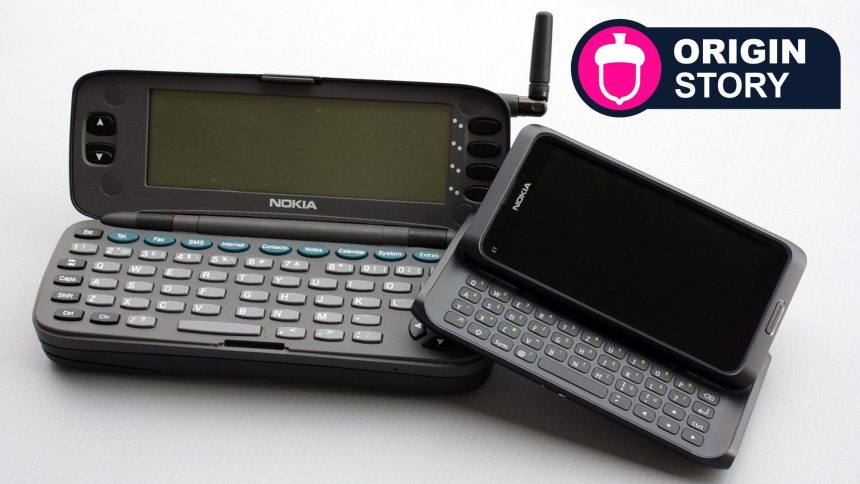
Thirty years ago today, on August 15, 1996, Nokia dropped a brick into the pocket of the world’s business elite. The Nokia 9000 Communicator weighed a hefty 397 grams (14.0 oz), cost around $800 in the US and £1,000 in the UK, and did things no phone had any business doing in the mid-nineties.
Flip it open — because open it did, clamshell-style — and you were greeted by a full physical QWERTY keyboard and a 4.5-inch, 640 x 200 pixel grayscale LCD. This wasn’t a phone with a few extra tricks. It was, in every meaningful sense, a pocket computer that happened to make calls.
Under the hood sat an Intel i386 CPU clocked at 24 MHz and 8 MB of memory, carved up thoughtfully: 4 MB for applications, 2 MB for program memory, and 2 MB for the user’s own data. Running the show was PEN/GEOS 3.0, a genuine operating system rather than a stripped-down feature menu.
What could you actually do with it? Quite a lot, as it turns out:
- Send and receive email over a 9.6 kbit/s GSM modem
- Send and receive faxes — very much a status symbol of the era
- Browse the web on a built-in browser
- Run a suite of business programs for the travelling executive
Reading that spec sheet in 2026, the shape of everything that followed is unmistakable. Email in your pocket, a real browser, a proper keyboard, apps running on top of an OS — the Communicator sketched the blueprint for the modern smartphone half a decade before the phrase entered common use, and more than ten years before the iPhone made touchscreens the default.
And that is precisely the sting. Nokia had the lead, the engineering muscle and a genuinely visionary product. “We were five years ahead,” is the kind of line that has haunted the company’s leadership ever since, because being early is only half the battle. The 9000 Communicator proved the concept, but Nokia never converted that head start into lasting dominance once Apple redefined the category and rewrote the rules around touch, apps and design.
The Communicator is long discontinued now, a museum piece rather than a market contender. But it deserves better than a footnote. Strip away the grayscale screen and the fax modem and you’re left with a philosophy that every flagship in your pocket today still follows: put a real computer in a phone-sized shell, and let people do their work from anywhere.
Thirty years on, the industry finally caught up to where Nokia already was in 1996. The tragedy is that Nokia didn’t stay there.