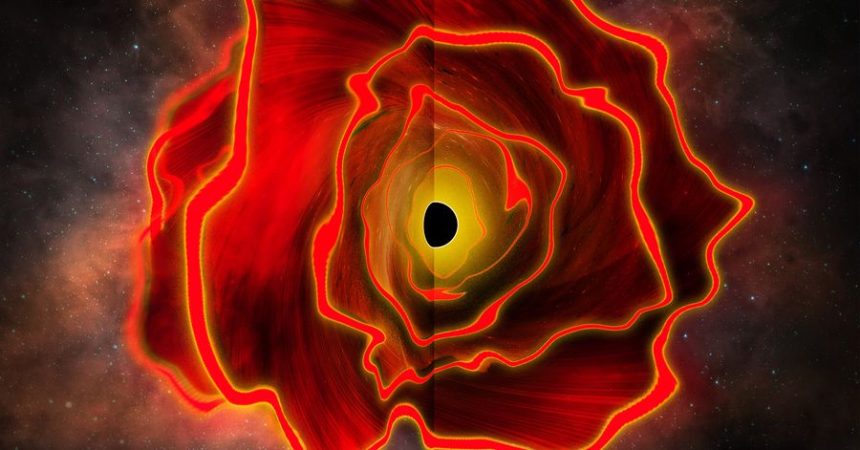
Soundgarden may have been more prescient than they knew. Astronomers have just made the case for a genuine “black hole star” — an object the size of our solar system, glowing an eerie deep red in the earliest reaches of the universe. The findings, published in Nature, lean once again on the James Webb Space Telescope, which keeps rewriting what we thought we knew about the cosmos.
The object at the heart of the study is called MoM-BH*-1, and its light comes from a time when the universe was just 660 million years old — a fraction of its current age of nearly 14 billion years. In JWST images it shows up as one of the many small, reddish dots that the telescope keeps stumbling across in the young universe.
From billions of light-years away, MoM-BH*-1 looks like a colossal star. But two properties give it away:
- It emits roughly 100 billion times more energy than any star could ever produce through nuclear fusion — extraordinary even for that early, bright era.
- Part of its light abruptly vanishes. Stars can do something similar when their atmospheres absorb certain wavelengths, but here the effect is far too intense to be ordinary stellar behavior.
Those clues point toward something stranger. Researchers believe MoM-BH*-1 hides a black hole at its center, greedily devouring matter and dumping enormous amounts of energy into an exceptionally dense, luminous envelope of gas around it. As that energy fights its way out through the gas, it picks up characteristics we’d normally associate with starlight — hence the disguise.
The idea neatly connects to another JWST puzzle: those countless “little red dots” scattered across the early universe, whose origins remain hotly debated. They don’t slot cleanly into any familiar category. Scientists have floated several explanations — compact, star-packed galaxies; black holes buried in dust; or systems entirely unlike anything we see nearby. Black hole stars are now firmly on that list.
What makes MoM-BH*-1 special is how thoroughly its black hole appears to drown out everything else around it. As lead author Rohan Naidu, who carried out the work while at MIT, put it: “Every little red dot is consistent with being a black hole star, embedded in a generic early galaxy. But what is special about MoM-BH*-1 is that the black hole star is essentially completely outshining its surrounding host galaxy, such that we’re seeing pure black hole star light.”
In other words, this may be the cleanest look yet at a cosmic object that hides a monster behind a starlit mask — and a strong hint that the early universe was populated by things we’re only beginning to recognize.