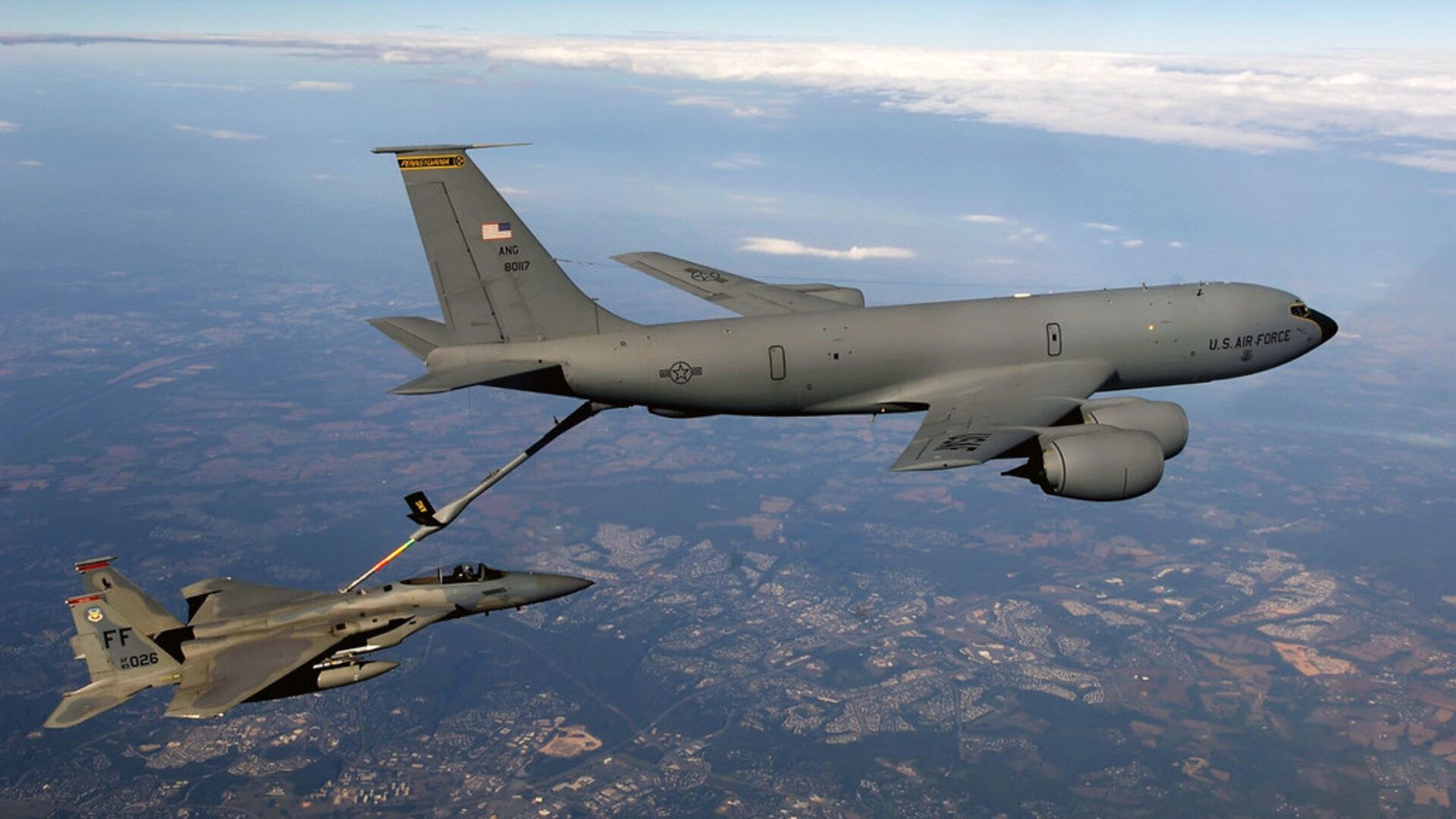
The aircraft that will one day replace the US Air Force’s KC-135 and KC-46 tankers might not have anyone in the cockpit. At the Air, Space & Cyber 2026 conference in National Harbor, Maryland, in September 2026, Lt. Gen. Daniel Tulley, commander of Air Mobility Command, said openly that crew is no longer a given for the service’s future refuelling aircraft.
“I do not believe that it has to be manned, a future air-refuelling solution… But then, how do we, the U.S. Air Force, bring that to bear in scope, scale, and range?” Tulley said. He also floated the options on the table: “Does it need to be manned? Could it be optionally manned, or could it be autonomous?”
The Navy’s drone opened the door
The idea gained traction thanks to the Navy’s Boeing MQ-25 Stingray, an unmanned carrier-based refuelling drone that flew for the first time earlier in 2026. In September 2026 the Navy cleared the MQ-25 for low-rate production and bought three more aircraft, bringing its order to 14.
The Air Force’s future tanker effort, known as the Next-Generation Air Refueling System (NGAS), is aimed at fielding in the mid-2030s. An analysis of alternatives is weighing concepts that range from a blended wing-body design to simply buying more KC-46s to a stealthy, possibly uncrewed platform.
Size is the real problem
Scaling the Stingray concept up to Air Force needs is where things get hard. Tulley noted that a tanker able to cover the required distances would be very large, and no fully autonomous aircraft of that size flies today. The numbers show the gap:
- KC-46 Pegasus: range just short of 7,400 miles, 212,000 pounds of fuel
- MQ-25 Stingray: roughly 500 miles, 14,000 pounds (up to 7.5 tons) of fuel
Money is thin as well. The Air Force spent $12 million in 2026 studying a new tanker design; its fiscal 2027 budget request zeroes out that line and asks for $13 million for advanced refuelling systems instead. Meanwhile, the service keeps buying crewed KC-46 Pegasus tankers, and in September 2026 it was preparing a contract for 75 more.
Autonomy by increments
Boeing’s aircraft can already take off, follow programmed routes and land on autopilot, although the Air Force does not operate them autonomously.
Merlin Labs, which builds autonomous flight systems, is one company pushing in that direction. It plans to install its autonomous pilot software on the C-130J, an aircraft in the same general size class as the KC-135. A human crew will stay on board, letting autonomy be added gradually. “That’s a way that you can start to chip away at that without actually going fully to the unmanned tanker right away,” said Merlin Labs CEO Matthew George. “The goal is that the unmanned tanker is ready, and the autonomy ends up being ready at the same time.”
Certification is the next hurdle, and Merlin says it is working closely with the Air Force on it during 2026. The company’s technology has completed a critical design review, but no date has been set for the C-130J to fly with its autonomous pilot. With no flight date and certification still open, a crewless tanker the size of the KC-46 remains a long-term prospect rather than a near-term program.