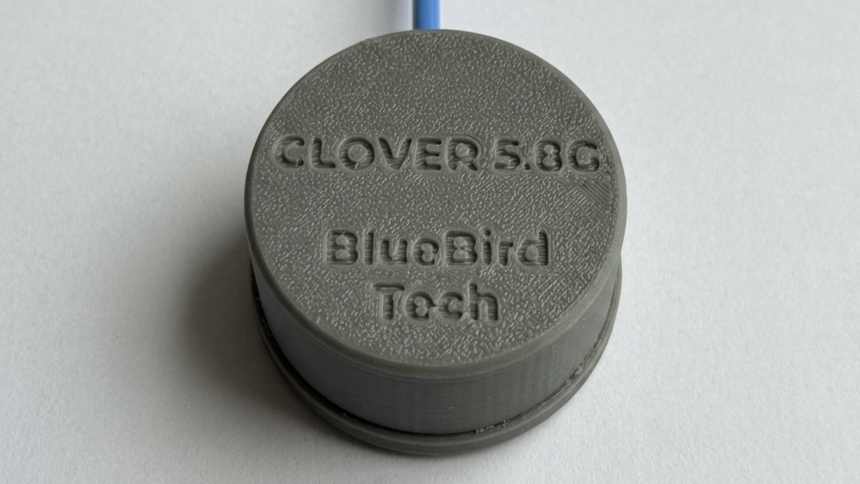
At just 25 grams, the CLOVER 5.8 GHz from Ukraine’s BlueBird Tech looks less like a piece of serious RF hardware and more like something you’d find clipped to a hobbyist’s quadcopter. Look past the weight, though, and this is a purpose-built antenna designed for drones, monitoring gear, measurement rigs and ground-based robotic platforms — the kind of kit where every gram and every decibel matters.
The antenna went on sale on August 10, 2026, and its calling card is versatility. Rather than locking users into a single narrow slice of spectrum, the CLOVER operates across a 4.9–6.1 GHz frequency range. That wide window makes it a flexible companion for the increasingly crowded 5.8 GHz band that dominates modern FPV and telemetry links, giving operators headroom to shift channels as conditions and interference demand.
Here are the key specs BlueBird Tech has confirmed:
- Frequency range: 4.9–6.1 GHz
- Gain: approximately 2 dBic
- Weight: 25 grams
- Dimensions: 144 × 47 mm
- Construction: PETG and copper
- Cabling: RG402 coaxial cable with SMA male connector
The circularly polarised design — hinted at by that dBic gain figure — is a deliberate choice. Circular polarisation helps combat multipath fading and keeps a link alive even when a drone is banking, rolling or flipping through the air, situations where a simple linear antenna would drop signal the moment its orientation changed. For anything that moves unpredictably, that resilience is worth far more than raw gain numbers on a spec sheet.
The material choices tell their own story. PETG is a tough, weather-tolerant printable plastic that shrugs off vibration and rough handling, while copper forms the radiating element itself. Pairing that with RG402 — a semi-rigid coax favoured for its low loss and mechanical stability — suggests BlueBird Tech built the CLOVER to survive field conditions rather than a lab bench. The SMA male connector is about as universal as RF connectors get, so integration into existing platforms should be painless.
What makes the CLOVER interesting isn’t any single headline figure but the balance it strikes. A modest 2 dBic gain won’t set records, yet combined with the featherweight body and broad frequency coverage, it fits neatly onto small airframes and lightweight robotic chassis where a heavier, higher-gain antenna would simply be dead weight — or throw off the whole flight envelope.
The result is a component that reads as pragmatic engineering: light enough to ignore, rugged enough to trust, and broad enough to keep working across the messy, contested slice of spectrum where these platforms actually operate. Whether it’s feeding a drone, a sensor array or a ground robot, the CLOVER 5.8 GHz makes a strong case that the most important upgrades sometimes weigh next to nothing.