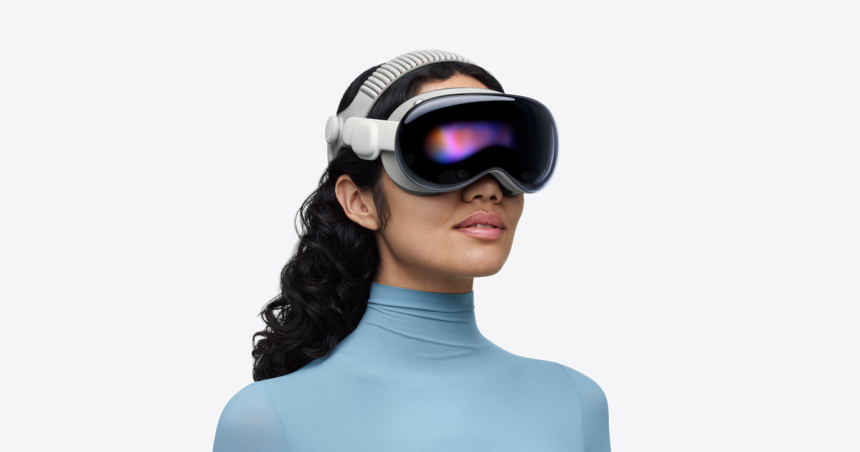
The man who spent seven years engineering Apple’s most ambitious wearable is walking out the door. Paul Meade, the VP who heads Apple’s Vision Products Group, is reportedly leaving next week to build OpenAI’s brand-new in-house hardware division, according to Bloomberg.
It’s a notable defection. Meade didn’t just dabble in spatial computing — he led hardware engineering for the Apple Vision Pro and had been spearheading the company’s long-rumored smart glasses effort. Before joining the Vision Products Group in 2017 (and taking over its hardware engineering a couple of years later), he worked on the iPad and the iPhone. In other words, OpenAI is poaching someone fluent in the entire arc of Apple device development.
At OpenAI, Meade will reportedly oversee a family of AI-powered devices. That puts him on interesting ground, because OpenAI already has a hardware partner: Jony Ive’s startup, io, which merged with the company in a $6.5 billion deal but continues to operate independently. The two have been developing AI gadgets together since 2025, and Ive’s studio is separately said to be working on its own lineup, including a smart speaker expected sometime in 2027. How a fresh internal hardware team will mesh with — or rub against — Ive’s group is the open question here.
Back at Apple, the gap left by Meade won’t go unfilled. Fletcher Rothkopf, one of the original founders of the Vision Pro team, is set to absorb many of his responsibilities. But the timing of the exit is telling: Bloomberg attributes Meade’s departure to the impending leadership reshuffle, with John Ternus — currently SVP of hardware engineering — taking over as CEO from Tim Cook on September 1.
The hardware itself remains very much alive. The Apple Vision Pro, now running the M5 chip, is still on sale, starting at US$3,699 for the 256GB model, with the 512GB version at US$3,899 and the 1TB at US$4,199. Under the hood, it pairs two 1.41-inch micro-OLED displays at 3660 × 3200 pixels each, running at 90 FPS and adjustable to 96 or 100 FPS. There are 12 cameras, 6 microphones and 5 sensors, plus the Optic ID iris scanner for authentication. It still tips the scales at over 1.3 pounds.
The headset launched in the US in February 2024 and rolled out globally through that year. Apple’s smart glasses, meanwhile, reportedly won’t arrive until the end of 2027 — a project Meade was helping shepherd, and one that now changes hands at a delicate moment. Losing the engineer who knew both the headset and the glasses inside out, just as the company swaps CEOs, is the kind of brain drain that’s hard to paper over with a press release.