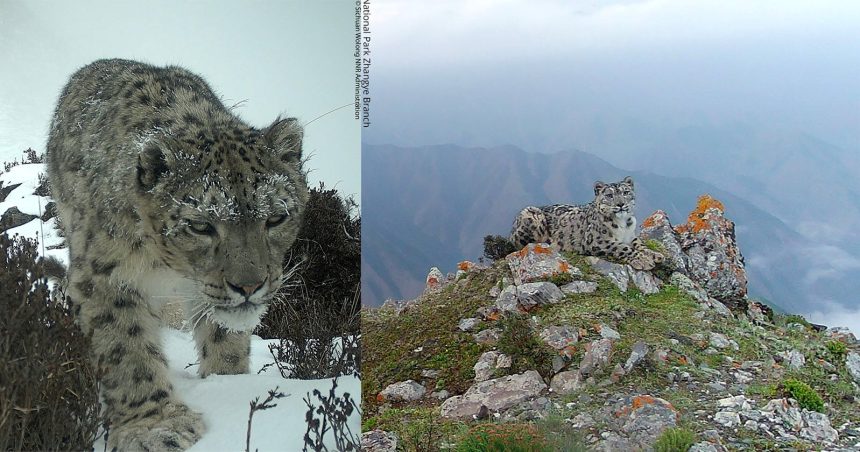
Getting a photograph of a snow leopard in the wild is one of the toughest assignments in wildlife imaging — the animals are solitary, camouflaged against rock and snow, and famously allergic to human company. That is exactly why the World Wide Fund for Nature (WWF) leaned on machines instead of people, and the results are extraordinary.
A camera trap survey led by WWF across remote alpine regions of China has produced a haul of stunning images of the world’s rarest feline. The network consists of 160 infrared cameras monitoring high-altitude terrain, including Qilian Mountain National Park — home to an estimated 150 snow leopards — and Wolong National Nature Reserve in Sichuan Province.
These are not ordinary cameras. The passive infrared units trigger automatically on movement and heat, and they are built to keep working in temperatures as low as -40 degrees Celsius (-40 degrees Fahrenheit). That resilience matters, because snow leopards live at punishing altitudes, usually between 3,000 and 4,500 meters. As WWF notes, the cats are well suited to the cold thanks to their thick, insulating fur — one memorable frame shows an individual with frost-tipped whiskers padding past a remote camera in Wolong.
The numbers behind the project are as impressive as the pictures. Across the survey, the camera network has captured over 600 photos of snow leopards across 157 separate sightings, according to Digital Camera World. One shot even resembles a two-cat selfie, catching a pair together in a single frame. Throughout 2025, WWF-China supported 10 snow leopard rangers in the area, contributing a total of 500 person-days of patrol effort.
Snow leopards were the target, but the cameras cast a wide net. The survey also documented a rich cast of alpine wildlife, including:
- Lynxes
- Ibexes
- Red deer
- Sichuan takin
- Wild dogs
- Foxes
That kind of incidental data is gold for researchers trying to understand a species that is notoriously difficult to study. Snow leopard habitat stretches across the mountainous regions of 12 Asian countries — Afghanistan, Bhutan, China, India, Kazakhstan, Kyrgyzstan, Mongolia, Nepal, Pakistan, Russia, Tajikistan, and Uzbekistan — covering close to 772,204 square miles, with roughly 60% of that range found in China.
The scale of what remains unknown is sobering: more than 70% of snow leopard habitat is still unexplored. Home ranges swing wildly, from 4.6 to 15.4 square miles in Nepal to over 193 square miles in Mongolia, and population density can range from under 0.1 to 10 or more individuals per 38.6 square miles depending on prey and terrain.
By quietly logging thousands of frames in places humans rarely reach, WWF’s camera network is turning a near-impossible research task into hard data — one frosty, wide-eyed portrait at a time.