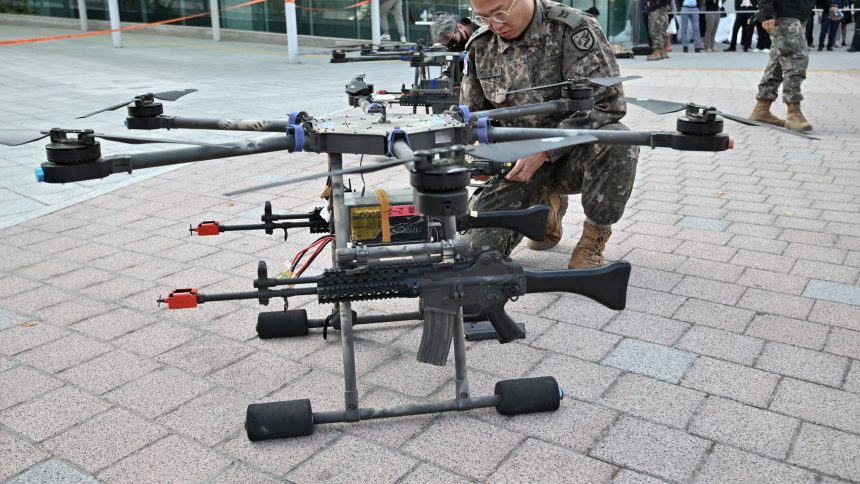
South Korea wants every soldier in its roughly half-million-strong military to fly a drone as instinctively as they handle a rifle. On June 26, Defense Minister Ahn Gyu-back laid out a plan to turn the drone into what he called a “universal combat tool” — a kind of “second personal weapon” issued across the ranks, according to a briefing reported by Reuters and other outlets.
The logic is plain. South Korea’s active-duty force stands at 450,000 personnel, while North Korea fields more than 1.2 million soldiers. Faced with that numerical gap across a 70-year border standoff, Seoul is leaning hard into the playbook written in Ukraine, where cheap, expendable drones became a force multiplier against a larger adversary. Ahn explicitly cited the wars in Ukraine and the Middle East as the inspiration for the reforms.
Alongside the training push, individual units are set to receive more low-cost surveillance and strike drones, backed by counter-drone lasers and microwave weapons. The military’s former drone operations command — which once held direct authority over combat units — is being reorganized to focus on working with domestic industry to develop and procure commercial drone technology, per The Korea Times.
The numbers behind the slogan
Despite the “500,000 drone warriors” framing, the rollout starts small. Ministry officials clarified that not everyone gets a drone, even for training. The plan begins with 11,000 training drones distributed to personnel this year, scaling toward 60,000 drones across the military by 2029.
There are real obstacles in the way:
- Shrinking manpower. South Korea’s conscript pool has been contracting amid a falling birthrate, and mandatory service still excludes women. Simply maintaining a 500,000-strong force may prove difficult.
- A trainer shortage. Min-Cheol Jung, cofounder of the South Korea–based counter-drone red team Team Retriever, flagged a shortfall of noncommissioned officers and officers needed to teach hundreds of thousands of conscripts.
- The China problem. Seoul wants drones built with 100 percent domestic components and zero Chinese parts, citing security concerns — China being North Korea’s principal economic and security partner. Yet China dominates the commercial drone market through manufacturers like DJI, and Jung doubts there are enough Chinese-free commercial drones to equip the entire force.
What Ukraine actually did
It’s worth noting that even Ukraine — the model everyone is copying — does not train every soldier as a drone pilot. Its edge comes from specialized operator teams backing front-line infantry, a dedicated Unmanned Systems Forces branch, a digital battle-management system, and a homegrown industry that mass-produces millions of drones a year while iterating fast.
South Korea isn’t acting alone, either. Meanwhile, North Korean soldiers who survived Ukrainian drone warfare on Russia’s side have begun rotating home to share what they learned.