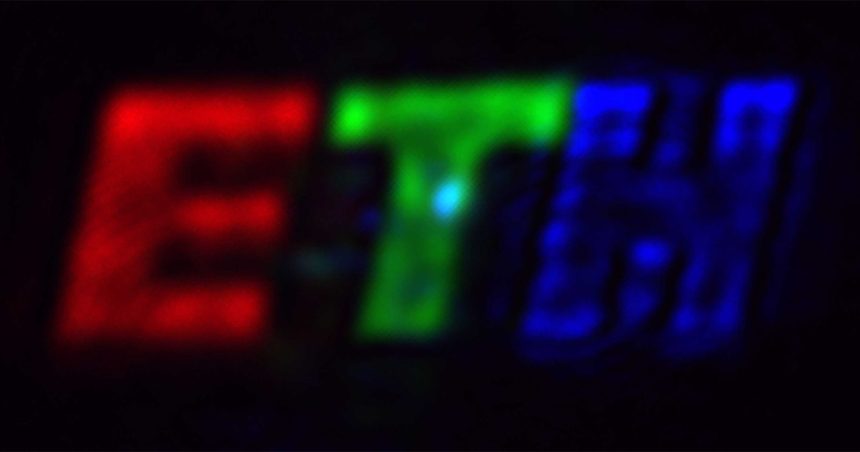
Imagine a single screen element that doesn’t just light up to show you a picture, but simultaneously soaks in the light landing on it. That’s the trick behind the so-called Fourier pixel, a device developed by researchers at ETH Zurich and published in Nature on June 24, 2026.
Conventional gadgets keep camera and display rigidly separate. Your phone has an imaging sensor on one side and a panel on the other, each doing exactly one job. The Fourier pixel collapses that division. The same structure can both emit and detect light, which means a future surface could, in principle, capture a scene and reproduce one at the same point in space.
What makes this more than a clever switch is the level of control involved. Rather than simply toggling brightness, the Fourier pixel manipulates three properties of light at once:
- Intensity — how bright the light is
- Oscillation phase — the timing of the light’s waves
- Polarization — the orientation in which those waves vibrate
By steering all three, the pixel can generate and sense arbitrary light fields. In plain terms, it isn’t limited to flat red-green-blue dots: it can shape light in ways ordinary screens and sensors simply can’t, which is where the “Fourier” name comes from — the mathematics of building complex waveforms out of simpler ones.
The obvious payoff sits in hybrid camera/display hardware. A device that records and shows light from the same surface opens doors to things like screens that capture your gaze without a separate front camera, or imaging systems that double as their own viewfinders. The researchers frame it as a building block rather than a finished feature, but the direction of travel is clear.
It’s worth being precise about what this is. The Fourier pixel is laboratory research, not a product you’ll find on a shelf. There’s no price, no release date and no consumer device attached to it. ETH Zurich has filed a patent application around the technology, and the work is in the running for this year’s Spark Award, the university’s prize recognising research with strong commercial potential.
That patent filing is the telling detail. Plenty of optics research stays buried in journals, but a patent application signals the team sees a path from bench to product. Whether that path leads to phones, AR glasses, or some category we haven’t named yet, the underlying idea — one surface that both sees and shows — is the kind of foundational shift that tends to ripple outward for years.
For now, the Fourier pixel lives in the lab and on the pages of Nature. But if it scales, the line between “camera” and “display” may eventually stop meaning very much at all.