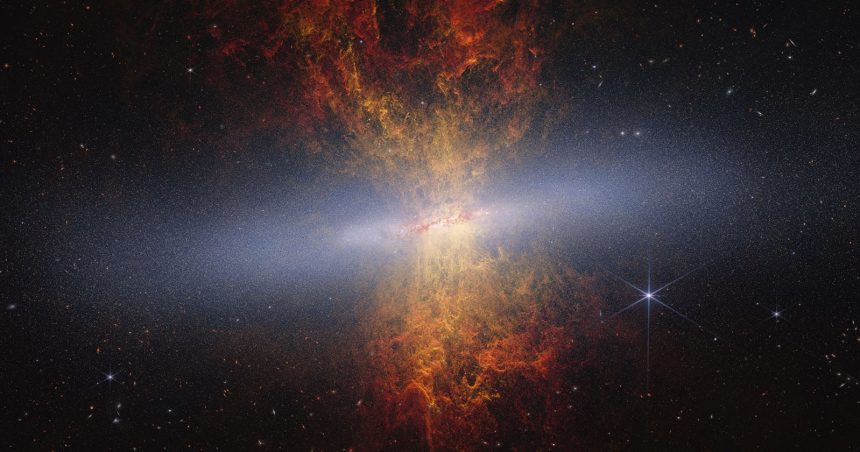
Three days of staring into deep space is a long exposure by anyone’s standards. That’s exactly what the James Webb Space Telescope committed to Messier 82, the bright, edge-on spiral better known as the Cigar galaxy. The payoff is a staggering 223-megapixel composite image that resolves an estimated 16.5 million individual stars — and surfaces details astronomers have never been able to see before.
The numbers alone are worth pausing on. JWST spent 65 hours — close to three full days — locked onto M82, gathering enough infrared light to build a frame dense enough to print on a billboard and still hold up under a magnifying glass. For comparison, your phone’s headline camera maxes out somewhere around 50 megapixels. This single image carries more than four times that, and every extra pixel is doing scientific work.
M82 is a favorite target for a reason. It’s a so-called starburst galaxy, churning out new stars at a furious pace, with dramatic outflows of gas and dust streaming from its core. In visible light, much of that drama hides behind thick dust lanes. Webb’s strength is seeing straight through them: its infrared instruments peer past the murk to pick out stellar nurseries, individual aging stars and structures that optical telescopes simply can’t reach.
What makes a 16.5-million-star headcount possible isn’t just sensitivity — it’s resolution and patience working together. A longer integration time lets faint points of light accumulate against the background, while Webb’s optics keep them sharp enough to be counted rather than smeared into a glow. The result reads less like a single photograph and more like a detailed census of a galaxy’s population.
- Target: Messier 82 (M82), the Cigar galaxy
- Observation time: 65 hours, roughly three days
- Image resolution: 223 megapixels
- Stars resolved: 16.5 million
None of this is a gadget you can buy, of course — JWST is a multi-billion-dollar observatory parked nearly a million miles from Earth, not a product on a shelf. But it’s a vivid reminder of where the frontier of imaging actually lives. The best camera ever pointed at the sky isn’t chasing megapixel bragging rights for marketing; it’s using every one of those 223 million pixels to map a galaxy star by star.
For anyone who obsesses over sensor specs and dynamic range, M82 is the ultimate aspirational shot: a three-day exposure of 16.5 million light sources, captured by a telescope that turns dust clouds transparent. It’s the kind of image that makes even flagship phone cameras look refreshingly humble.