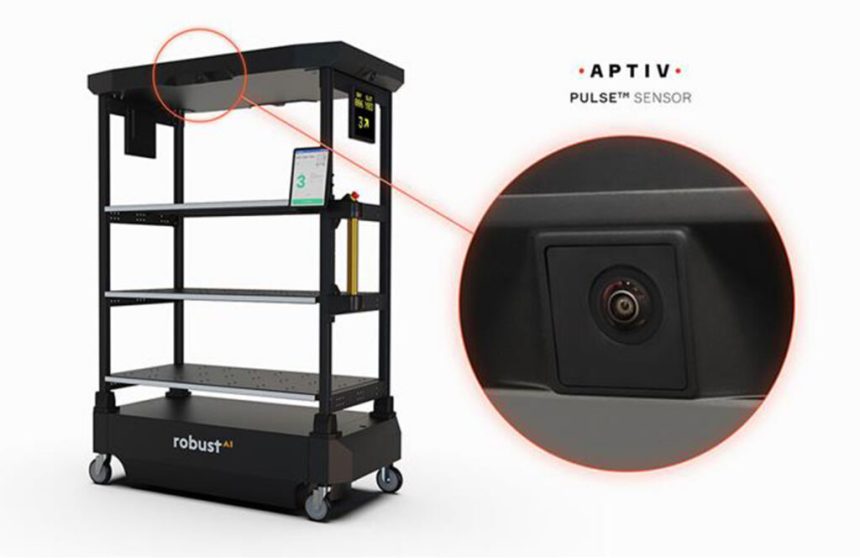
Mobile robots have spent years bumping awkwardly around human coworkers, treating every passing forklift driver like an unexpected obstacle to be feared. Robust.AI is taking a different tack with its Gen 3 Carter collaborative mobile robot, which now leans on the Aptiv PULSE sensor to actually understand the busy environments it rolls through.
The headline upgrade is sensor fusion done properly. Rather than processing radar and camera feeds in separate silos, Aptiv PULSE blends raw detections from both using AI and machine learning. That means Carter isn’t just reacting to a blob of pixels or a radar return — it’s combining the two into a single, confident picture of what’s actually moving around it. For a robot whose whole job is sharing floor space with people, that distinction is the difference between cautious and genuinely safe.
The sensing setup pairs a surround-view camera with ultra-short-range radar to deliver true 360-degree awareness. There are no blind spots for a wandering coworker to step into, which is exactly the kind of guarantee a warehouse operator wants before turning autonomous machines loose in a shared aisle.
Carter brings plenty of its own hardware to the partnership, too. It features a 360° AI-optimized vision system and navigates using camera-based vSLAM, mapping its surroundings on the fly rather than relying on rigid pre-programmed routes. Its patented holonomic drive lets it move in any direction — sideways, diagonally, on the spot — which makes tight, crowded spaces far less of a headache.
The collaborative side of the equation is built into the chassis. A force-sensitive handlebar lets a human grab the robot and guide it like a smart cart, while whole-robot force sensing means Carter can detect contact across its entire body and respond gently. It’s less an autonomous machine that tolerates people and more a teammate designed to work shoulder to shoulder with them.
Robust.AI showed the Gen 3 Carter off at Automate 2026, where it sat on display at the Aptiv booth #3291 following the announcement on June 23, 2026. The pairing makes sense: Aptiv’s sensing pedigree comes largely from the automotive world, where fusing radar and vision to keep cars from hitting things is well-trodden ground. Bringing that maturity indoors, where the stakes involve human coworkers at close range, is a natural extension.
Robust.AI offers Carter through a Robotics-as-a-Service model rather than selling the hardware outright, so there’s no sticker price to quote here. What’s clear is the direction of travel: warehouse robots are getting smarter about the messy, unpredictable presence of actual humans — and that’s the only way they’ll ever earn a permanent spot on the floor.