Building humanoid robots is expensive, and Agility Robotics just lined up a fresh tank of fuel. The Oregon company behind Digit, the bipedal warehouse worker, is heading to the public markets through a merger with Churchill Capital Corp XI, a deal announced on June 24, 2026 that should raise US$620 million.
That money has a clear destination: scaling up Digit v5 and clearing a backlog of customer orders. Agility expects to close the transaction before the end of 2026, so as of now the merger is still pending rather than done.
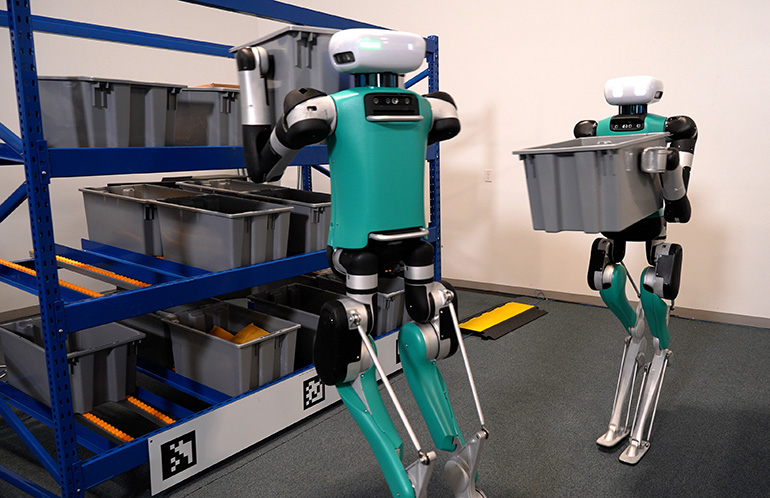
If you haven’t met Digit, picture a machine built to fit into spaces designed for people. It stands 5’9″ (175 cm) and weighs 143 pounds — roughly the proportions of an average adult, which is the whole point. Warehouses, conveyors and shelving were laid out for human bodies, and a humanoid frame slots into that world without rebuilding the building.
Under the panels, Digit carries 16 degrees of freedom and a 16 kg payload capacity. In practical terms it can lift and move packages up to 35 pounds, walk at 1.5 m/s, and keep going for 4+ hours on a charge before it needs to top up.
Perception is where things get genuinely clever. Digit uses four Intel RealSense depth cameras for full 360-degree spatial awareness, backed by onboard LiDAR that builds high-resolution 3D maps of its surroundings. That sensor stack is what lets a humanoid navigate a busy fulfillment floor without colliding with the humans, totes and forklifts sharing the space.
This isn’t a lab demo chasing a viral clip. Digit is already in commercial trials and running pilot programs inside Amazon fulfillment centers, doing the kind of repetitive tote-handling work that wears people down. The economics are starting to make sense for buyers too, even with a starting price of US$250,000 — a number that says Digit is squarely an industrial tool, not a consumer toy.
The SPAC route itself is worth a raised eyebrow. Blank-check mergers fueled plenty of overheated EV and space startups in recent years, and the structure has a reputation for outpacing the underlying business. Agility’s pitch is different in one key respect: it has a shipping product, paying pilots and a marquee customer in Amazon, rather than a render and a roadmap.
The broader story here is momentum. Humanoid robotics has spent years promising that general-purpose machines would eventually earn their keep in logistics. Agility is one of the first to put real hardware on real warehouse floors and then ask public investors to bankroll the next chapter.
Whether US$620 million is enough to turn Digit from a promising pilot into a fixture of everyday distribution centers is the open question. But the direction is unmistakable: the robots that were supposed to take our warehouse jobs now want a ticker symbol too.