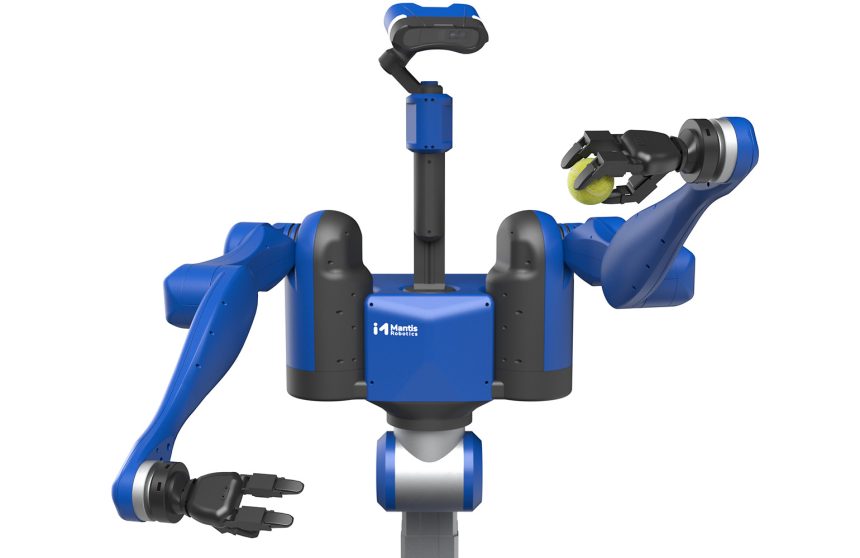
Industrial robots have long lived behind fences, locked away from humans because they swing heavy payloads at speeds that don’t tolerate mistakes. Mantis Robotics wants to tear those cages down. At Automate 2026 in Chicago on June 22, the company unveiled the MR-X, a biomimetic dual-arm robot built to work shoulder-to-shoulder with people — no safety enclosure required.
The pitch is flexibility. Traditional automation forces you to design the workspace around the robot’s danger zone. Mantis flips that logic: a fenceless machine can slot into messy, crowded, real-world environments and be reconfigured on the fly. That’s a meaningful shift for factories that can’t afford to bolt down a permanent cell every time the line changes.
What makes it credible is the safety stack. The MR-X runs on Mantis’s patented SafetyCore platform, described as a reflex system that gives the robot full, continuous awareness of its surroundings. Think of it less as a robot that stops when it bumps something, and more as one that perceives what’s around it and reacts before contact — the difference between a flinch and a bruise. The design is built to meet ISO 10218-1 and ISO 13849-1, the standards that govern industrial robot safety and the integrity of safety-related control systems.
The hardware doesn’t pull punches either. The MR-X is a genuinely capable machine:
- Dual arms with a biomimetic design, mimicking how a human pair of arms coordinates rather than relying on a single rigid limb
- Lifts up to 70 pounds
- Moves at speeds up to 10.6 m/s
- A compact footprint that keeps it from eating up valuable floor space
Those numbers are worth dwelling on. A 10.6 m/s top speed is fast — the kind of velocity that normally screams “keep your distance.” Pairing that with a fenceless certification target is the whole point: Mantis is betting that perception and reflexes can replace steel barriers without sacrificing throughput.
The two-arm format is the other piece. Most collaborative robots offer a single arm and ask you to choreograph everything around it. A coordinated dual-arm setup can hold, brace, and manipulate simultaneously — handing a part from one gripper to another, stabilizing a workpiece while the other arm assembles it. It’s closer to how a human actually works at a bench, which is exactly the kind of task automation has historically struggled to absorb.
For now, the MR-X isn’t something you can buy. Mantis is taking waitlist registrations, with the robot not yet available for sale. Pricing hasn’t been disclosed, and given how much rides on real-world deployment data, the company is likely keeping its powder dry until early customers put SafetyCore through its paces on actual factory floors.
If it delivers on the promise, the MR-X represents the version of industrial automation many people imagined years ago — fast, dexterous, and unafraid to share the room.