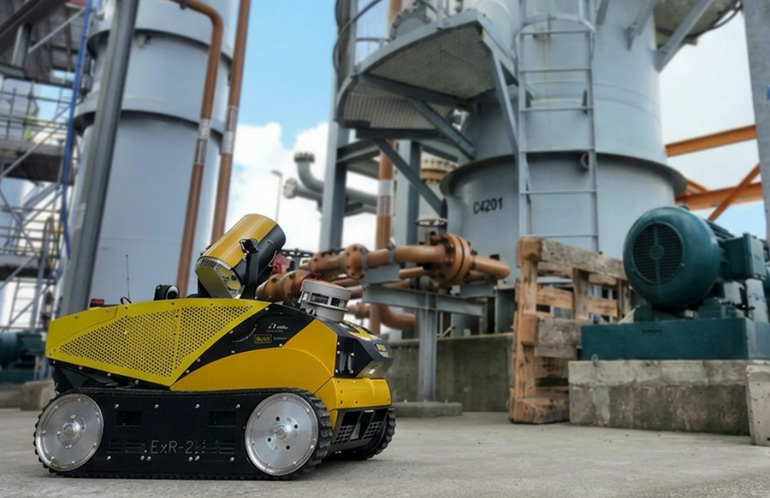
Walking an inspection round through an oil refinery or chemical plant is the kind of job nobody wants to do at 3 a.m. in a -40°C wind, surrounded by gas that could ignite at the wrong spark. ExRobotics built the ExR-2.5 to take that walk instead — and it now has the paperwork to prove it can do so safely in North America.
The headline news is certification. The ExR-2.5 carries UL approval for operation in explosive gas locations, the regulatory gatekeeper that decides whether a machine is allowed anywhere near a live hydrocarbon facility on this side of the Atlantic. ExRobotics rolled the robot out for the North American market on June 24, 2026 at the Energy Drone & Robotics Summit in Houston, and it is now available across the region.
Underneath the explosion-proof casing sits a genuinely capable inspection platform. The robot rides on a high-performance LiDAR system that handles autonomous navigation and obstacle detection, threading through cluttered process areas without a human at the controls. It pairs that with high-resolution cameras for visual checks and a thermal imaging camera tuned to catch overheating equipment and temperature anomalies long before they become incidents. Artificial intelligence, plus enhanced thermal and audio sensing, lets it flag the kind of subtle anomalies — a faint hiss, a creeping hot spot — that a tired night-shift operator might miss.
Endurance is where the ExR-2.5 earns its keep. It is rated to work in temperatures from -40°C to +55°C, trundles along at 2 km/hour, and runs missions lasting 2 to 6 hours depending on the route. ExRobotics says it is designed to complete 2-3 missions daily for 6+ months without anyone needing to physically intervene — a meaningful claim in environments where every human visit is a safety event in itself.
That self-sufficiency is the whole point. The economic and safety logic of sending a robot into a hazardous zone collapses the moment a technician has to climb in after it. By targeting half a year of hands-off operation, ExRobotics is pitching the ExR-2.5 less as a gadget and more as permanent infrastructure — a tireless patrol that frees skilled staff for work that actually requires a human brain.
On commercials, ExRobotics is keeping its options open. There is no publicly disclosed purchase price, but the company offers three-year leasing contracts with annual fees alongside a Robot-as-a-Service model, letting operators treat inspection as an operating cost rather than a capital outlay.
It is a sober, unglamorous product for a sober, unglamorous problem — and that is exactly why it matters. The ExR-2.5 won’t go viral, but for plant managers staring down aging assets and shrinking inspection crews, a UL-certified robot that walks the dangerous miles for them is a very easy sell.