Getting an industrial robot off the loading dock and into productive work has long been the part of automation nobody likes to talk about. It’s slow, it’s specialized, and it usually requires an integrator fluent in a particular brand’s quirks. Vention wants to flatten that learning curve, and it has just signed up two heavyweights to help.
At Automate 2026 in Chicago, Vention announced an expanded collaboration with FANUC America alongside a separate strategic tie-up with Universal Robots. The common thread is what the company calls software-defined automation: the idea that a manufacturer should be able to design, simulate and deploy a robotic cell mostly in software, then snap the hardware together like building blocks.
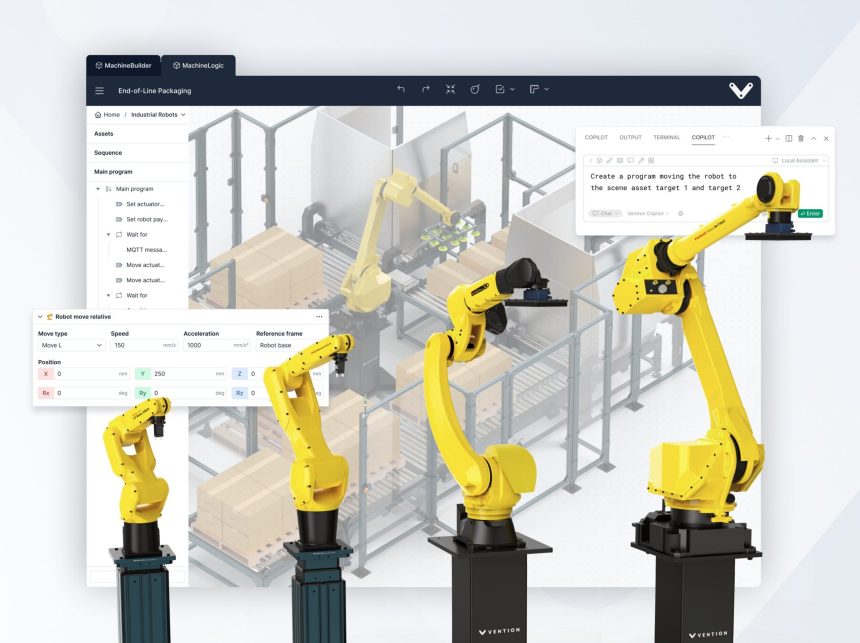
The FANUC partnership, announced on June 22, 2026, leans on AI-powered programming, digital twin technology and modular automation. In practice that means a customer can configure a workcell virtually, test it against a digital twin before a single bolt is tightened, and lean on AI to handle the tedious parts of robot programming that traditionally demand specialist expertise.
Underpinning all of this is Vention’s own stack. The platform brings together several pieces that have become familiar to its users:
- MachineMotion AI — the controller layer that orchestrates motion and automation hardware
- MachineLogic — for sequencing and programming robot behavior
- MachineBuilder — the design environment where cells are assembled in the cloud
By extending support across a range of FANUC and Universal Robots models, Vention is effectively offering manufacturers a single design surface that doesn’t care which brand of arm sits at the center of the cell. That’s a meaningful shift for shop-floor teams who would otherwise juggle separate toolchains for each vendor.
The Universal Robots collaboration follows the same logic, aimed at accelerating the deployment of modular automation. UR’s collaborative robots — designed to work safely alongside people rather than behind cages — are a natural fit for the plug-and-play philosophy Vention has been building toward. The pitch to small and mid-sized manufacturers is straightforward: less integration overhead, faster time to a working line, and fewer reasons to keep automation projects stuck in committee.
None of this was framed as a boxed product with a price tag. These are B2B partnerships and technology demonstrations, shown at Automate 2026 rather than launched onto a store shelf. But the direction of travel is clear. The companies driving industrial robotics are increasingly betting that the hard part isn’t the steel — it’s the software that makes the steel useful, and how quickly a non-specialist can put it to work.
For manufacturers weighing whether to automate, a world where a cell is designed in a browser, validated against a digital twin and bolted together from standard modules is a far less intimidating proposition than the one they grew up with.