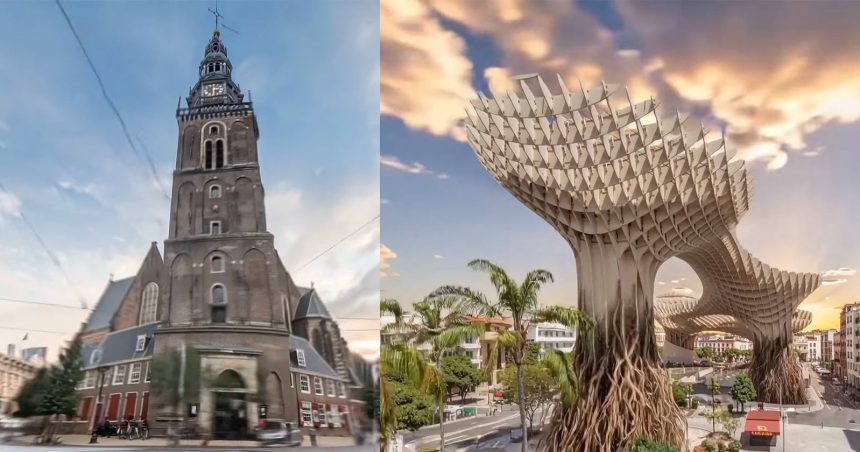
Ten cities, roughly 100,000 photos, several terabytes of footage — and two bicycles lost to thieves along the way. That’s the tally from Ukrainian photographer Kirill Neiezhmakov’s most ambitious project yet: a timelapse tour that ran from the southern tip of Europe all the way to northern Germany, producing 10 hypnotic hyperlapse films in the process.
The journey opened in Seville in mid-July, with the Andalusian capital baking under 44 degrees Celsius (111 degrees Fahrenheit). Neiezhmakov quickly adopted the local siesta to wait out the worst of the afternoon heat, hunting for patches of shade just to plant his tripod. By Valencia, he’d landed on the “seamless flight” visual concept that became the signature of the whole series.
Analog craft meets AI wizardry
The head-spinning transitions between locations lean on AI video-to-video morphing, and Neiezhmakov cycled through three models: Pixverse, Kling, and Seedance 2.0. Pixverse, he says, is “capable of surprisingly creative and unexpected transitions” but unpredictable — at one point it spontaneously conjured a white cat leaping out of a window and diving into a fountain. Its saving grace is that it’s cheap enough to keep experimenting.
By Lyon he’d switched to Kling, which “follows prompts significantly more precisely,” letting him write multi-part instructions describing motion direction, lighting shifts and architectural texture — and land a usable result on the first try far more often.
The gear behind the aesthetic
The optical backbone of the project is a Laowa 15mm f/4.5 Zero-D Shift lens, chosen to defeat the classic “falling buildings” distortion of architectural work. Rather than tilting the camera upward and cropping heavily in post — expensive when you’re dealing with compressed RAW sequences — Neiezhmakov physically shifts the lens element upward, keeping the sensor plane parallel to the facade and preserving every pixel of resolution.
Most frames are four- to five-second exposures, producing those silky motion trails of people and traffic. That rules out a gimbal entirely: any micro-correction “appears as a smear or shake in the frame at exposures longer than roughly half a second.” Instead he relies on a tripod paired with a Vertecfoto GH-V5 geared head, locking a fixed reference point — a window edge, a lamp post — in exactly the same spot each time, then nudging the tripod forward 15–30cm per shot.
A brutal solo grind
Each city got about three days of shooting, yielding 40 to 60 sequences of 150–300 frames apiece. Post was the real marathon: two to three days on RAW processing, color grading and stabilization in After Effects, then two to three weeks per video for assembly, AI transitions, sound design and finishing — three to four weeks total per film.
And the bicycles? One was stolen on his first night in Lyon (Vélo’v city bikes bailed him out), the replacement vanished from a busy Rotterdam rack in broad daylight barely a week later. “Physically exhausting and financially draining,” he calls it — but a masterclass in resilience.