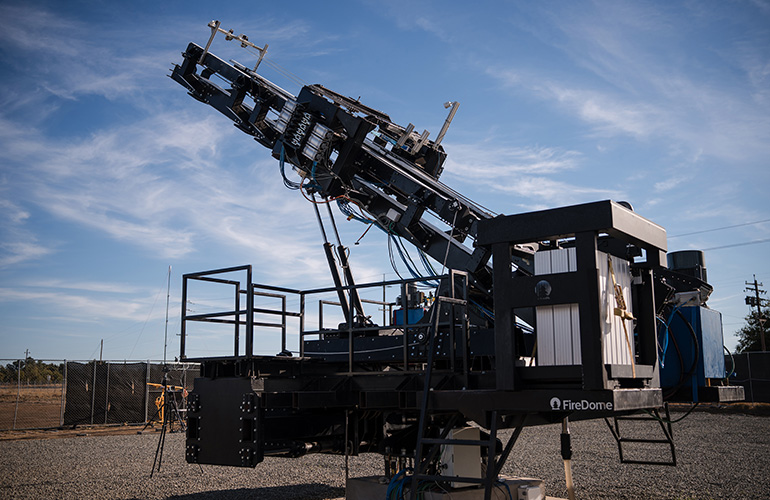
Wildfires rarely take homes in one dramatic wall of flame. Far more often, the damage comes from wind-borne embers that land on roofs, decks and dry brush, start small spot fires, and set off a chain reaction long before a fire crew can reach the street. FireDome, a startup based in Tel Aviv, is building an autonomous ground-based launcher designed to break that chain. Its goal is to coat a property in fire retardant before the embers arrive and to deal with spot fires within seconds.
The Robot Report described the system on October 6, 2026. It looks less like a sprinkler network and more like a piece of robotic artillery. A mechanical launcher, with no explosives involved, throws liquid-filled capsules across a radius of about 1,000 ft. (304.8 m), which works out to roughly 70 acres (28.3 hectares) per installation.
How it works
- Capsules: each holds roughly 10 gal. (37.8 liters) of standard or eco-friendly fire retardant, or plain water where that is appropriate.
- Airburst delivery: capsules open mechanically a short distance above the ground (a few to a few dozen feet) instead of on impact. Each one spreads an elliptical pattern roughly 15 to 25 ft. (4.5 to 7.6 m) long and seven to 12 ft. (2.1 to 3.6 m) wide.
- Sensing: on-site cameras and environmental sensors watch the protected area, then detect and triangulate small fires started by embers. The targeting algorithms take into account wind speed and direction, temperature, humidity, topography and fuel layout.
Protection comes in three layers. First, the launcher autonomously lays down perimeter firebreaks. Second, it coats critical structures that were identified during a site survey. Third, it hunts and suppresses spot fires using on-site monitoring. “We want to cut off this domino effect by covering structures ahead of time, so when an ember meets the fire retardant, it doesn’t become a spot fire,” says CEO and co-founder Gadi Benjamini.
Autonomy doesn’t mean the system can’t be overridden. “The system is autonomous, and they can shut it off. It starts on its own, and both the customer and firefighters have the ability to intervene remotely,” Benjamini explains. When FireDome announced its first real-world demonstration on October 30, 2025, it showed the launcher rotating, adjusting range and aiming in real time. It also showed safety algorithms that recognize humans, animals, vehicles and aircraft.
Benjamini and CTO Dr. Adi Naor Pomerantz founded the company in early 2024. According to The Robot Report, FireDome has built and deployed its first full demo system at a site in Yuba County, California. The company uses it to show the technology to fire agencies and potential clients and to collect feedback on the design. The next steps are final design and manufacturing, and the first production units are planned for deployment in spring 2027.
The business model is wildfire resilience as a service. Early adopters pay $10,000 to $15,000 per month, which covers a risk survey, system design, installation and annual maintenance. Customers who prefer to own the hardware can buy it outright as a CapEx purchase and pay a lower ongoing fee for maintenance and service. Target customers include residential communities and HOAs, resorts and hospitality properties, data centers, oil and gas facilities, solar farms and other critical infrastructure in wildfire-prone regions.