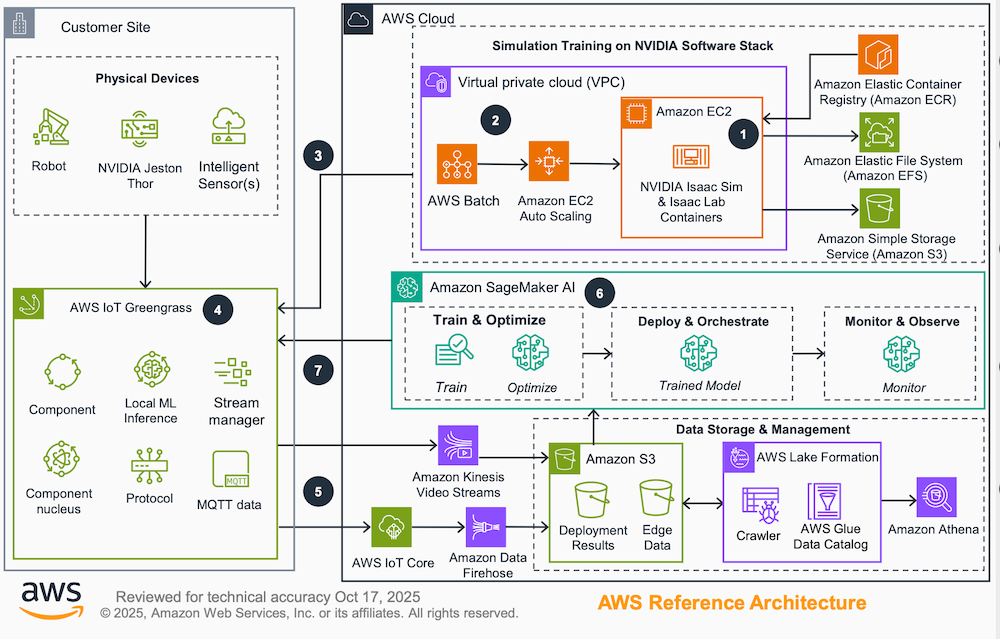
Building a robot brain usually means stitching together a pile of tools: one for generating training data, another for training, a simulator for testing, and a separate system to push the model onto the machine. On October 8, 2026, Amazon Web Services launched an open-source Physical AI Toolchain that puts those steps into a single workflow, using AWS cloud services alongside NVIDIA’s Physical AI software stack.
The pitch is simple. Sri Elaprolu, director of Frontier AI Science and Engineering at AWS, told The Robot Report that the goal is to “make this easy button, if you will” for roboticists moving from raw data to a model running on real hardware.
Five stages, one loop
The toolchain covers the full lifecycle of a robot model:
- Synthetic data generation: producing training data without collecting all of it in the physical world
- Model training: handled by Amazon SageMaker
- Simulation and validation: testing behaviour before a robot ever moves
- Edge deployment: distributing models to devices through AWS IoT Greengrass
- Continuous improvement: data from robots in the field goes back to the cloud to refine the models
NVIDIA supplies the robotics-specific parts: Isaac Sim, Isaac Lab, Isaac GR00T and Cosmos. Teams can use the components together or pick out individual pieces.
Hardware-agnostic by design
AWS doesn’t tie the toolchain to a particular robot. It provides the infrastructure and leaves the choice of machine to the developer. “The toolchain is intentionally staying neutral to that final step,” Elaprolu said. That fits the range of customers AWS mentions. Japanese company Telexistence has deployed more than 300 humanoids in convenience stores, which are messier places than a factory floor. “The fault tolerance levels tend to be much lower, but at the same time, the response rates have to be much higher,” Elaprolu noted.
Dexterity is another focus. AWS worked with South Korean firm RLWRLD on a specialised tactile-sensing model for five-finger manipulation tasks, after finding that existing models weren’t capable enough. Bedrock Robotics trains models on AWS for autonomous construction robots that then run equipment on real job sites.
Lessons from a million robots
Amazon has an unusually large internal test bed. Elaprolu said the toolchain draws on lessons from Amazon’s own robotics operations, which include more than 1 million robots. One of them is Vulcan, Amazon’s first robot with a sense of touch, which picks and stows items in fulfillment centers and was named 2026 Robot of the Year by The Robot Report.
Not RoboMaker 2.0
Anyone remembering AWS RoboMaker, the cloud robotics simulation service that shut down in 2025, might see this as its successor. AWS says it isn’t a direct replacement: RoboMaker was one component of a robotics stack, while the new toolchain covers a much broader set of development tools. Many of those pieces are already proven. Companies in AWS’s Physical AI Fellowship, run with MassRobotics and NVIDIA, have used the individual AWS and NVIDIA components. The toolchain packages them into a more cohesive workflow, released as open source.