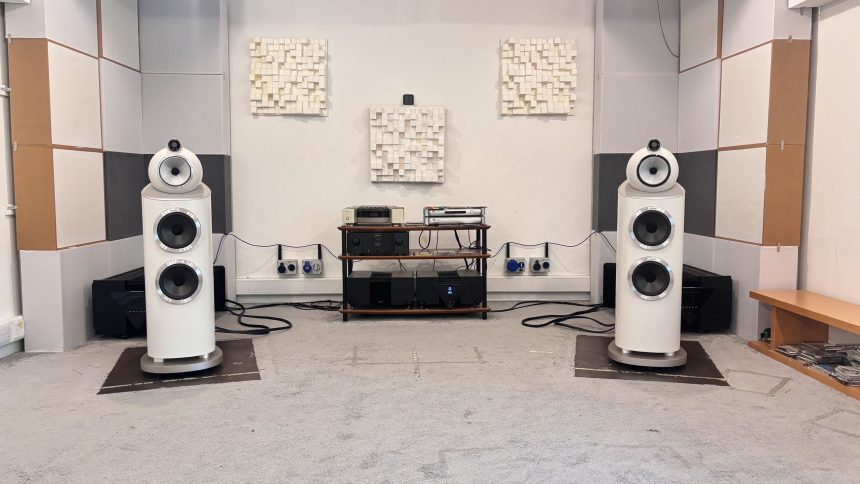
Bowers & Wilkins has rebuilt its flagship loudspeaker line from the ground up, and the new 800 Series Diamond D5 arrives as a full seven-model family. If you’ve followed the brand’s obsession with iterative refinement, the D5 tag signals another generation of tweaks to a formula that already sits at the very top of the high-end audio pyramid.
The range breaks down into five stereo speakers and two dedicated center channels. Here’s how the lineup and US pricing shake out:
- 801 D5 — US$65,000/pair
- 802 D5 — US$45,000/pair
- 803 D5 — US$35,000/pair
- 804 D5 — US$25,000/pair
- 805 D5 — US$15,000/pair
- HTM81 D5 — US$15,000 each
- HTM82 D5 — US$12,000 each
The 801 D5 remains the halo product and the clearest showcase of B&W’s engineering language. It’s a three-way design built around dual 10-inch Aerofoil bass drivers, a six-inch Continuum Cone FST midrange housed in the brand’s signature Turbine Head, and the famous Diamond Dome tweeter perched on top. On paper it reads like a serious partner for muscular amplification: 90dB sensitivity, an 8 ohm nominal impedance that dips to a minimum of 3.5 ohms, and a recommended power window spanning 50-1000 watts.
That impedance dip and the wide power range are worth taking seriously. This is a speaker that rewards a well-specified amplifier and punishes a weedy one, which is entirely in keeping with the company’s history of demanding, revealing flagships.
Buyers get four finishes to choose from across the family: Stealth Black, Dark Walnut, Light Walnut, and Warm White. The two lighter walnut options and the Warm White in particular suggest B&W is thinking about listening rooms that double as living spaces rather than blacked-out man-caves.
The D5 series was unveiled at High End Vienna 2026 in early June, the perfect stage for a launch aimed squarely at the audiophile faithful. Anyone tempted to commit will need a little patience and a lot of budget: the speakers go on sale starting September 9, 2026.
Listening to the entire range back-to-back against the outgoing generation is a genuinely fascinating exercise — the kind of comparison that reveals just how much of B&W’s identity carries over and how much has been quietly reworked. On first impressions, the D5 family looks like a confident evolution rather than a reinvention, which is exactly what you’d expect from a lineup that already defines the reference class. The question, as always, is whether the differences justify the price of admission — and at these numbers, that’s a very personal calculation.