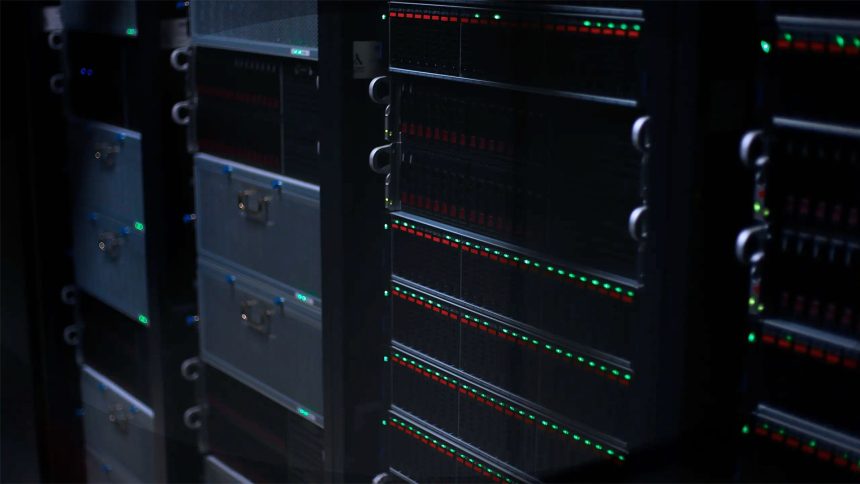
Lithium-ion is banned from the one place data centers could most use it: right next to the servers. Pack enough energy-dense cells beside a hot rack and you invite thermal runaway, the chain-reaction fire that keeps facility managers awake at night. Cambridge-based SuperDielectrics thinks it has a way around that problem, and it starts with an ingredient you already trust not to ignite — water.
The company’s Faraday 3 is a water-based zinc battery. Roughly half of it is water, which means there is simply nothing inside to sustain a runaway fire. That single property changes where you can put it. Instead of shunting energy storage into a separate, fire-rated building, SuperDielectrics wants to mount the battery directly onto the server rack itself — parking energy storage in the exact spot lithium-ion is forbidden.
The pitch here is about absorbing AI’s brutal, spiky power demands. Modern accelerators draw power in violent bursts, and rack-level storage that can soak up those spikes without catching fire is genuinely useful. The company has floated a bigger idea too: turning entire data centers into distributed energy storage. Asked whether that was on the table, the answer was blunt — “We have not ruled this out.”
What makes this more than a safety story is the performance, backed by independently published test results:
- Cold-weather charging — at 0°C, charge performance is roughly 48 times better than comparable lithium-ion cells
- Fast charge — a 20C charge rate, equivalent to a three-minute charge
- Fast discharge — 100C discharge in 36 seconds
- Cycle life — up to 13 times longer during high-power cycling, measured on 10-minute charge and discharge cycles at 100% depth of discharge
Those numbers matter for the AI use case. A battery that shrugs off aggressive, high-power cycling without degrading is exactly what a rack full of hungry GPUs needs, and the cold-weather figure hints at deployment flexibility that lithium struggles to match without elaborate thermal management.
The chemistry leans on a patented polymer separator, the piece SuperDielectrics credits for both the safety profile and the fast-charge behavior. Zinc and water are cheap and abundant, which sidesteps some of the supply-chain anxiety hanging over lithium and cobalt — though the company hasn’t disclosed pricing, so the real economics remain an open question.
The independent test results are already out, and the first commercial deployment is planned for early 2027. If Faraday 3 delivers at scale what the lab data suggests, the notion of a battery living inside the rack — rather than banished to a bunker down the hall — could quietly rewrite how AI data centers are built. For now, the technology has cleared the credibility bar that matters most: someone other than the manufacturer checked the numbers.