For decades, astronomers chasing an Earth-like world worked through a checklist. Are there rocky planets out there? Yes. Do any sit in a star’s habitable zone, where liquid water can survive? Also yes. But one box stayed stubbornly unchecked: does any of them still hold onto an atmosphere? Now, at last, there’s a yes for that too.
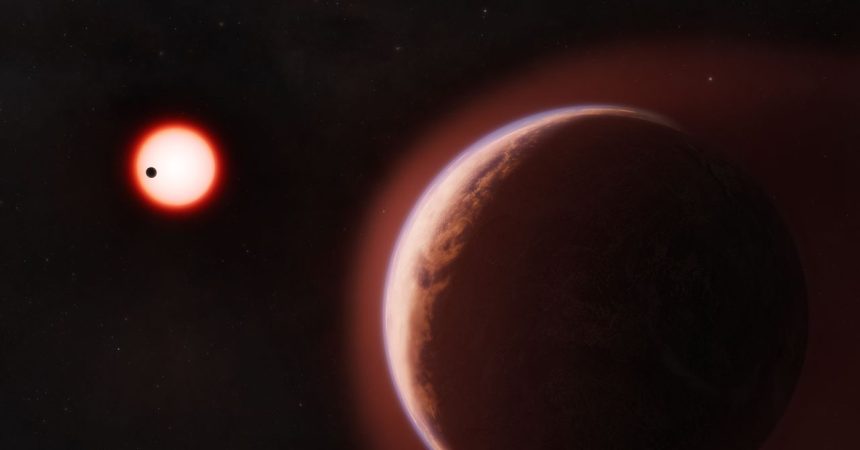
Researchers at the Harvard-Smithsonian Center for Astrophysics have confirmed the first rocky exoplanet that ticks all three boxes at once. Its name is LHS 1140 b, it orbits a cool red dwarf, and it sits 48 light-years from us. That makes it arguably the closest thing to an Earth relative we’ve found — if not a twin, then certainly family. The findings landed in the journal Science this week.
Why does an atmosphere matter so much? On Earth, it’s the reason water stays liquid rather than boiling off or sublimating away. It buffers the climate, regulates temperature, and shields the surface from harmful space radiation. Without it, a planet in the perfect orbital sweet spot is still a dead rock.
Detecting an atmosphere across 48 light-years is not a matter of taking a photo. The team went looking for helium leaking from the planet. First they picked up the spectral signature of the gas, then built physical models to reconstruct how it escapes into space. The escaping helium is strong evidence not only that an atmosphere exists, but that it has persisted for at least 3 billion years. The planet itself was discovered back in 2017; the atmospheric verdict rests on fresh observations gathered in 2024 and 2025.
Before anyone starts drafting a welcome banner, a reality check. Being in the habitable zone is not proof of life, or even of Earth-like conditions. Judging by how much helium is bleeding away, the researchers suspect this atmosphere is quite unlike ours. The helium comes from the upper layer, the easiest one to read. Below it could lurk heavier gases such as nitrogen, carbon dioxide, or carbon monoxide.
The real breakthrough may be the method. The study proves the helium-leak technique actually works for characterizing distant atmospheres, opening a path for follow-up with more powerful instruments. The next steps: map the atmosphere in detail and hunt for surface oceans or anything else compatible with habitability.
Study co-author and Harvard professor Robin Wordsworth framed the arc neatly: “Twenty years ago we wondered whether other terrestrial-type planets even existed. Then we learned they’re common, and found some in the habitable zone. The next question was whether any of them had managed to keep an atmosphere. Now, we know at least one has.”
It’s a milestone that quietly rewrites the search for a second Earth — one confirmed atmosphere at a time.