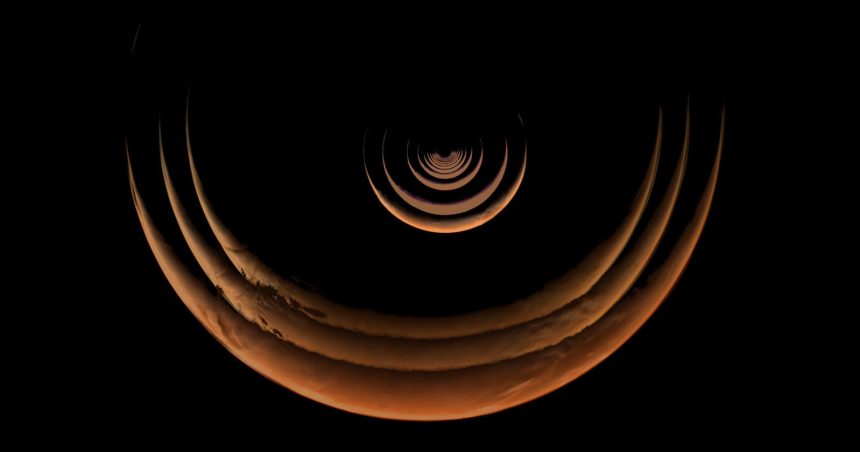
Spacecraft usually treat planets as gravitational pit stops, but NASA’s Psyche orbiter turned its May encounter with the Red Planet into a full-blown photo shoot. Throughout May 2026, Psyche approached, swung past and departed from Mars, and its cameras never stopped clicking.
At closest approach the probe came within just 2,864 miles (4,609 kilometers) of the Martian surface. That flyby wasn’t for sightseeing — it was a gravity assist, borrowing a slingshot of momentum from Mars to help propel Psyche toward its true destination, the metal-rich asteroid of the same name. But the mission team wasn’t about to waste the view.
The result, released by NASA’s Jet Propulsion Laboratory (JPL), is a timelapse stitched together from thousands of individual frames captured during the encounter. Watching it, you get a rare sense of scale and motion: Mars grows from a distant point of light into a fully resolved world, then shrinks away again as the spacecraft continues on its long haul across the solar system.
What makes the sequence so striking is the perspective. Most of us know Mars from static rover selfies and orbital maps. Here, instead, the planet behaves like a moving object — rotating, brightening, and slipping past the frame — precisely because it’s the camera doing the traveling. It’s the difference between a portrait and a flyover, and Psyche delivers the latter with cinematic clarity.
Gravity assists like this are a staple of deep-space navigation. By stealing a fraction of a planet’s orbital energy, a spacecraft can gain speed and adjust its trajectory without burning precious fuel. Missions from Voyager to Cassini have leaned on the technique, and Psyche’s Mars swing is a textbook example — with the added bonus of a spectacular imaging opportunity.
For anyone who follows space hardware, the footage is also a reminder of how capable modern spacecraft cameras have become. Turning a routine trajectory maneuver into a month-long visual document requires precise pointing, careful exposure management and the confidence to keep the shutter open while everything is in motion.
- Mission: NASA Psyche, en route to the asteroid Psyche
- Event: Mars gravity-assist flyby during May 2026
- Closest approach: 2,864 miles (4,609 kilometers)
- Released by: NASA Jet Propulsion Laboratory (JPL)
The timelapse is freely available to watch, and it’s well worth a full-screen viewing. It’s not every day you get to ride shotgun past another planet — even if the real prize still lies millions of miles ahead.