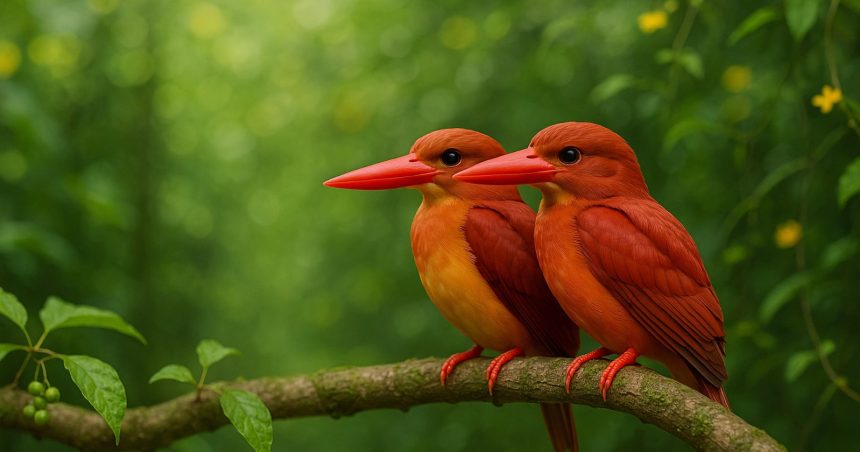
The pursuit of the perfect bird shot has a new hazard, and it isn’t a spooked kingfisher. Scientists are warning that wildlife photographers leaning on AI editing tools risk polluting the very databases researchers rely on to track where species live and how their habitats are shifting.
According to a report by The Guardian, researchers are urging photographers to think twice before uploading AI-tweaked images to birding platforms and forums. The concern centers on citizen science repositories such as iNaturalist and the Macaulay Library, which pool millions of public observations into data that scientists use to map species distributions.
In a commentary published in Nature and cited by The Guardian, researchers said hundreds of fake images have already been flagged on popular species-recording databases. The trouble is that no one knows the true scale — plenty of altered photos likely slip through unnoticed, quietly corrupting public records.
The problem isn’t only fully synthetic images. Some photographers use generative tools for what feels like harmless cleanup — removing a branch or a leaf blocking the subject. Those small edits can accidentally rewrite the details that matter most for identification.
“Wildlife photographers can be quite obsessed with getting a beautiful photo, but there’s a risk that the image might actually cause problems down the line when AI has been used to edit it,” Dr Alexander Lees, an ecologist at Manchester Metropolitan University who authored the journal article, told The Guardian.
Lees pointed to a striking case: a supposed red-winged blackbird photographed in central Brazil, thousands of kilometers outside its usual North American range. The bird turned out to be an epaulet oriole, a common New World species. But the photographer had asked an AI platform to make the image “look better,” and in the process the software grafted on red-winged blackbird features — manufacturing a false record of a bird that was never there.
For scientists, the implication is unsettling. Databases like these work precisely because the crowd is enormous and mostly reliable. Inject enough convincing fakes and the signal drowns in noise.
“My experience of looking at Facebook these days is that a huge volume of wildlife photos now are simply AI-generated imagery,” Lees added. “The idea that we could maybe use those photos to help us understand where species are in space and time is very difficult.”
Citizen science organizations are still gauging how bad it is. On iNaturalist, only 1,400 of the platform’s more than 610 million images have been flagged for AI use so far — a tiny fraction that may reflect either a small problem or, more worryingly, a detection gap.
The takeaway for anyone who shoots wildlife: a cleaner frame isn’t always a better one. When your photo might one day help a scientist chart a species’ fate, honesty in post-processing stops being a stylistic choice and becomes part of the data.