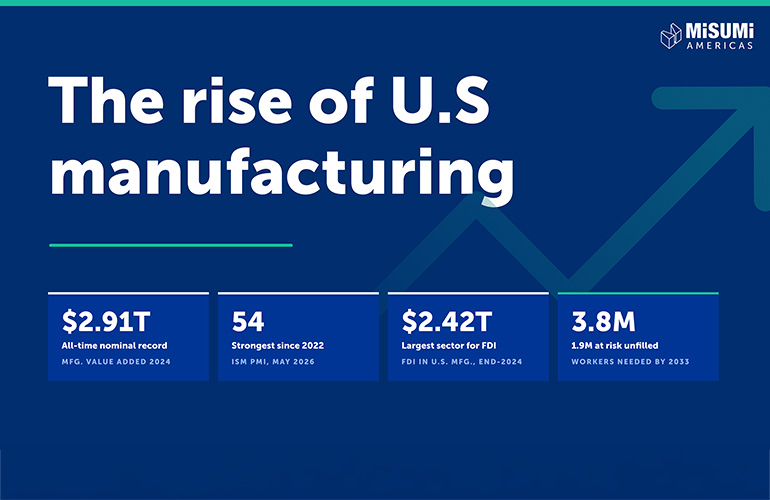
Bringing manufacturing back to American soil sounds like a straightforward win, but MISUMI Americas has just laid out why the reality is far more tangled. The company released its 2026 State of Manufacturing and Supply Chain Report, a deep dive into the forces pushing U.S. producers to reshore operations — and the stubborn obstacles standing in their way.
The headline tension is one the industry keeps bumping into: you can build all the factories you want, but someone has to run them. Reshoring is accelerating, driven by supply chain shocks, tariff uncertainty and a strategic hunger to shorten the distance between design and delivery. Yet the skilled workforce needed to staff those revived production lines simply isn’t materializing fast enough.
That’s where MISUMI’s second move comes in. The company threw its support behind H.R. 9097, a piece of legislation aimed at sending American workers overseas for hands-on manufacturing training. It’s a counterintuitive idea at first glance — dispatching people abroad in the name of domestic industry — but the logic holds up. Much of the world’s most advanced production know-how still lives in facilities outside the United States. Getting American technicians into those environments to absorb techniques, tooling standards and automation workflows could accelerate the learning curve dramatically.
For a supplier like MISUMI, which deals in the mechanical components and factory automation parts that keep production lines humming, this is more than corporate goodwill. A robust, well-trained manufacturing base is the customer base. If reshoring stalls because plants can’t find qualified operators, engineers and maintenance staff, the whole reshoring narrative risks becoming a policy talking point rather than a functioning reality.
The report frames the challenge in practical terms rather than lofty rhetoric. Reshoring isn’t just about capital investment or geopolitics — it’s about closing a widening skills gap that automation alone can’t paper over. Even the most sophisticated robotic cells need humans who understand how to program, calibrate and troubleshoot them.
- Reshoring momentum is real, fueled by supply chain resilience concerns and shifting trade dynamics
- The workforce shortage remains the critical bottleneck
- MISUMI backs H.R. 9097 to fund overseas training for U.S. workers
- Advanced automation still depends on skilled personnel
What makes the position noteworthy is its honesty about complexity. Too often, reshoring is pitched as a simple flip of a switch — pull production out of overseas plants, drop it back home, done. MISUMI’s report pushes back on that fantasy, arguing that the human infrastructure has to be rebuilt alongside the physical one. And if that means American workers temporarily gaining expertise abroad before applying it at home, so be it.
It’s a pragmatic stance from a company with skin in the game, and a useful reality check for anyone watching the reshoring wave build. Factories are the easy part. People are the hard part.