A new heavyweight has stepped into the humanoid arena, and it arrives with serious backing. Walden Robotics emerged from stealth on July 15, 2026, carrying a US$1.1 billion valuation and a roster of major technology investors — an eye-catching debut for a company that only came together in January 2026.
The founding team spun out of the Toyota Research Institute, and that pedigree is more than a line on a résumé. Walden’s approach is what it calls full-stack physical AI: the hardware, the software and the learning systems all built to work as one.
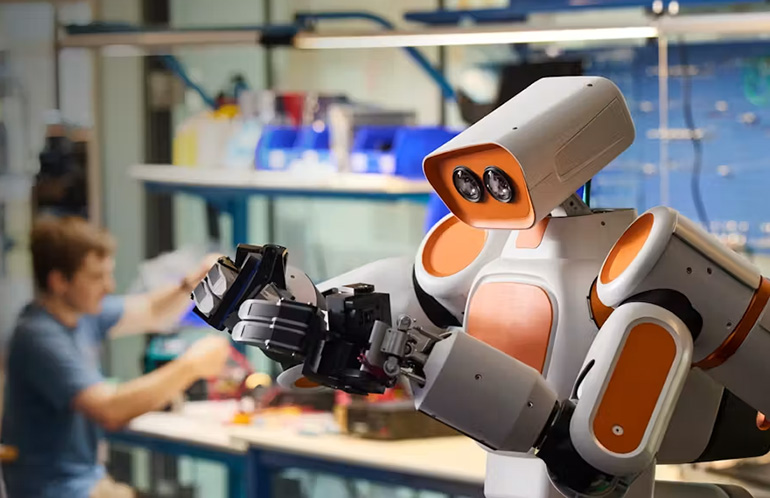
Forget the shiny bipedal walkers that dominate promotional reels. Walden’s robot takes a more pragmatic form — a humanoid torso with two arms mounted on a wheeled base. It’s a design choice that trades acrobatic balance for stability and reach, which makes sense once you look at where these machines are meant to earn their keep: the factory floor.
The real story here is how the robot learns. Walden leans on Large Behavior Models (LBMs) paired with Diffusion Policy, a machine-learning technique that lets a robot pick up complex, multi-step skills by watching human demonstrations rather than being painstakingly programmed line by line. The payoff is speed: instead of months of coding for a single task, the machine can be shown what to do and generalize from there.
And the task list is genuinely industrial. According to the company, its robots can handle:
- Machine tending
- Tool setting
- Parts kitting
- Assembly
These aren’t demo-day party tricks. Walden’s general-purpose robots have been doing useful work in production at a Toyota plant in North America since February 2026 — months before the company even revealed itself publicly. That order of events is telling. Where many robotics startups launch on a promise and a rendering, Walden showed up with hardware already clocking shifts.
The bet underpinning the whole venture is that a single, adaptable platform can shoulder a range of jobs that today demand a patchwork of fixed automation cells. If LBMs can reliably transfer skills between tasks, a plant could redeploy the same robot from kitting one week to assembly the next, without ripping out and re-tooling a rigid production line.
There are still open questions. Walden hasn’t disclosed a model name, a unit price or deployment numbers beyond the Toyota pilot, so it’s too early to judge how the economics stack up against incumbent industrial arms. General-purpose dexterity in unstructured environments also remains one of robotics’ hardest problems, and a controlled automotive plant is a friendlier proving ground than, say, a chaotic warehouse.
Still, the combination of a Toyota lineage, live production work and a billion-dollar-plus valuation puts Walden firmly among the companies worth watching as physical AI moves from the lab into the workday.