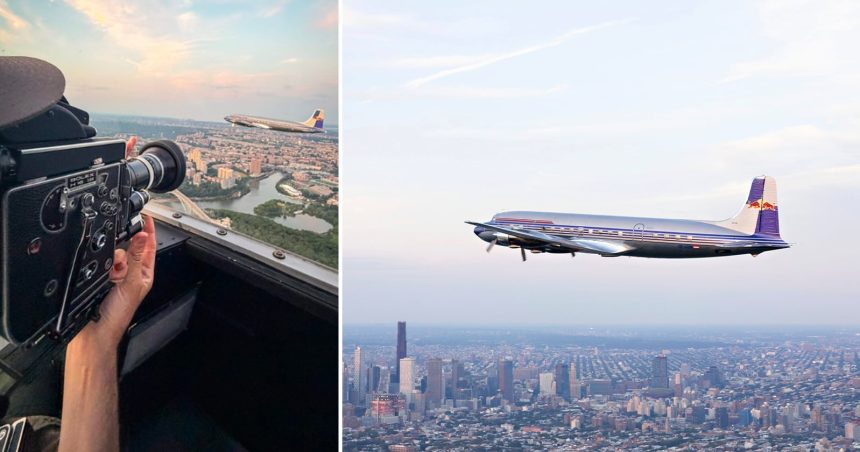
Some homecomings deserve more than a smartphone clip. When Red Bull’s historic DC-6B lifted off over the United States for the first time since it rolled out of a Santa Monica, California factory in 1958, the crew reached for gear worthy of the moment: hand-cranked Bolex motion picture cameras built in the same era as the aircraft itself.
The idea is beautifully simple. This four-engine propliner is 68 years old, a survivor from an age when air travel meant polished aluminum, radial engines and a certain analog romance. Shooting its return on modern digital cinema cameras would have looked crisp — and completely wrong. So the production team leaned into period accuracy, letting film stock and vintage optics do the storytelling.
The result, dubbed DC-6 x Bolex, pairs a 2026 sensibility with the visual character of analog film. Bolex cameras — Swiss-made, spring-driven, famously robust — render color, grain and motion in a way no software filter truly replicates. The tiny imperfections that digital tools work so hard to erase are exactly what give the footage its authenticity here.
New York City served as the first stop on the aircraft’s series of flights across American skies. There’s a neat symmetry to it: a plane that first took to the air in the late 1950s, captured on cameras from the same decade, flying over a skyline that has changed almost beyond recognition since then.
Why does this matter to a tech and gadgets audience? Because it’s a sharp reminder that older imaging tools aren’t obsolete — they’re a distinct aesthetic. The current wave of interest in film photography, Super 8 revivals and analog video isn’t nostalgia for its own sake. It’s about the texture and physicality that mechanical cameras bring to a frame, qualities that increasingly feel scarce in an era of computational photography and AI-assisted everything.
A few things worth appreciating about the Bolex approach:
- Mechanical reliability — spring-wound drives mean these cameras can roll without a battery in sight.
- Optical character — vintage lenses and film chemistry produce a look that’s genuinely hard to fake.
- Deliberate shooting — limited film runs force careful, considered framing rather than spray-and-pray capture.
It’s also a smart bit of production thinking. Red Bull could have thrown drones and gimbals at the shoot; instead it matched the tool to the subject, and the footage is stronger for it. When the story is about heritage, the medium becomes part of the message.
The DC-6B lives on in Red Bull’s aviation collection, and this flight series marks a rare chance to see a genuine piece of postwar aviation history back where it belongs. That it’s being documented on gear of the same vintage only makes the tribute complete — a fitting salute from one era of engineering to another.