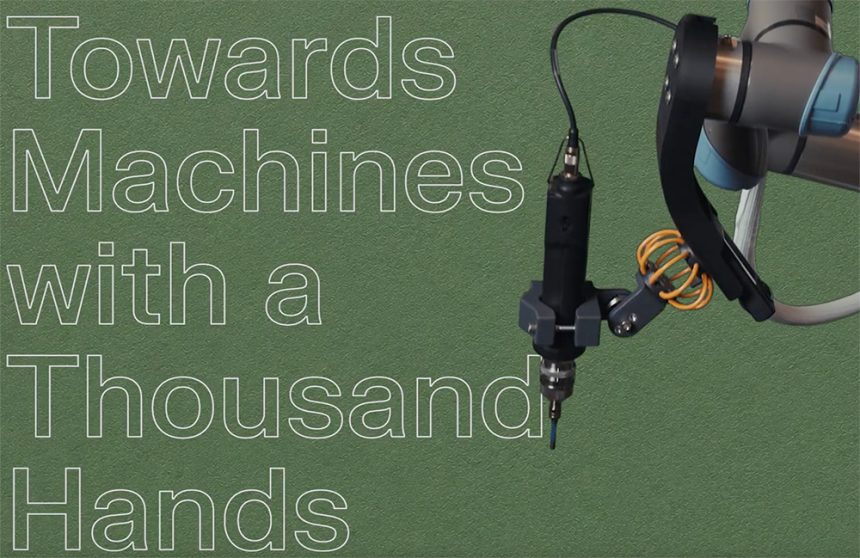
Robots come with a bewildering variety of hands. Parallel-jaw grippers, suction cups, multi-fingered manipulators — each one traditionally demands its own painstakingly trained control policy. Generalist AI wants to collapse all of that into a single foundation model, and its latest update to GEN-1 pushes that idea further by adding support for a whole range of robot end effectors.
The pitch is deceptively simple. Instead of building a bespoke sensorimotor policy for every new robot and every new hand, GEN-1 learns to operate them from one shared base. Generalist says that by training the model to work with new end effectors, that single foundation can pick up dexterous behaviors across radically different hardware. In practice, that means the same underlying intelligence can drive a two-fingered gripper on one arm and a more articulated manipulator on another, without starting from scratch each time.
The technical case behind GEN-1 is what makes this ambitious rather than incremental. Generalist, founded in 2024, trained the model on more than half a million hours of real interaction data spanning a wide variety of end effectors — a scale that helps explain why the system generalizes rather than memorizing one robot’s quirks.
The performance figures are the headline. GEN-1 reaches 99% success rates on tasks, a dramatic jump from the 64% managed by previous models. It also completes tasks roughly 3x faster than the prior state of the art. Perhaps most striking for anyone deploying robots in the real world, GEN-1 requires only 1 hour of robot data to train on a given setup — a fraction of what conventional approaches demand.
That combination of accuracy and data efficiency is exactly what a foundation model for robotics needs to be useful outside a lab. High success rates matter little if every new gripper means weeks of data collection. By slashing the training requirement to an hour and letting one base model absorb multiple end effectors, Generalist is chasing the thing that has eluded robotics for years — hardware-agnostic dexterity that scales.
GEN-1 first debuted in April 2026, and the end effectors support arrived in July 2026. For now, access remains gated: the model was made available in early access to selected partners, so this is not yet something you can wire up to an arbitrary arm in your workshop.
Still, the direction is clear. If a single foundation model really can learn new hands with an hour of data and hit near-perfect task success, the economics of deploying capable robots shift considerably. Generalist is betting that the future of robotics looks less like a fleet of narrowly trained machines and more like one adaptable brain that can pick up whatever hand you give it.