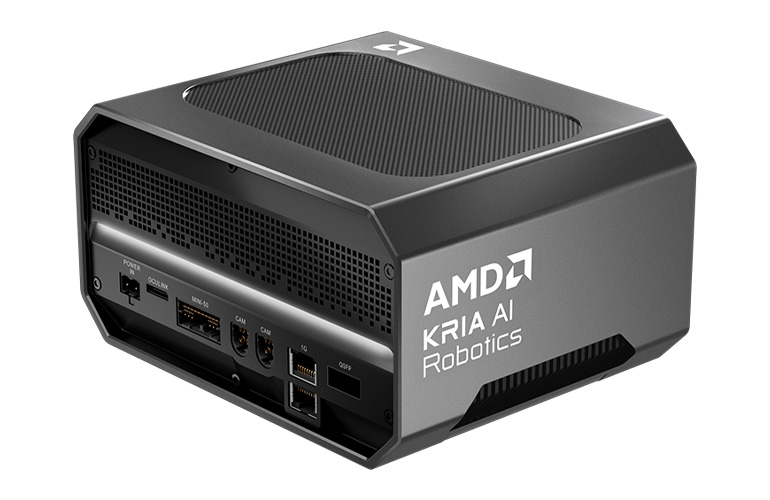
AMD is done playing spectator in the robotics arena. At the Advancing AI 2026 conference on July 23, the company pulled the wraps off the Kria AI System-on-Module, a compact powerhouse built around the new Ryzen AI Embedded X100 series. The pitch is blunt: unified memory, real-time control and enough compute to make NVIDIA glance nervously over its shoulder.
The headline trick here is the combination of heterogeneous silicon on a single module. AMD packs up to 16 “Zen 5” CPU cores for deterministic real-time control, an RDNA 3.5 integrated GPU for graphics and vision workloads, and a power-efficient NPU to shoulder the neural network heavy lifting. That trio matters in robotics, where a machine has to see, think and move without the milliseconds of latency that separate a smooth grasp from a dropped payload.
Feeding all of that is a genuinely eye-catching memory subsystem. The module carries 128 GB of LPDDR5X-8533 unified memory delivering roughly 135 GB/s of bandwidth. Unified is the operative word: CPU, GPU and NPU all draw from the same pool, which sidesteps the costly data-shuffling that plagues split-memory designs. For robots juggling perception, planning and control loops simultaneously, that shared address space is a real advantage.
AMD is keen to talk numbers on the AI side too. The platform is rated to scale up to 234 concurrent agents and churn through as many as 8,000 decisions per second — figures aimed squarely at multi-agent autonomy and swarm-style deployments rather than a single arm on a bench.
All of this arrives in a tidy 120mm × 120mm COM-HPC module footprint, small enough to slot into humanoids, autonomous mobile robots and industrial controllers without demanding a rack-sized enclosure.
- CPU: up to 16 “Zen 5” cores for real-time control
- Graphics: AMD RDNA 3.5 integrated GPU
- AI: dedicated power-efficient NPU, up to 8,000 decisions/second, up to 234 concurrent agents
- Memory: 128 GB LPDDR5X-8533 unified, ~135 GB/s
- Form factor: 120mm × 120mm COM-HPC
The catch, as ever, is access. This is a developer-grade platform, and the price is expected to exceed $5,000 — firmly in engineering-team territory rather than hobbyist budgets. AMD says the Kria AI SOMs will reach the market through ODM partners starting in Q4 2026, so the modules aren’t on shelves yet.
Strategically, this is AMD staking a serious claim on the physical-AI moment. Robotics has quietly become the next battleground for edge compute, and by fusing its CPU, GPU and NPU expertise into one embedded module with a huge unified memory pool, AMD is making a credible case that it can be more than an also-ran. Whether ODMs and robot builders bite when the modules ship later this year is the question that will define round two.