Shipping code to a fleet of robots scattered across fields, construction sites and warehouses is one of robotics’ quiet headaches. Every over-the-air (OTA) update has to squeeze through spotty connectivity, land on wildly different hardware, and — crucially — not brick the machine mid-task. Agency Tool Co. thinks it can make that whole process far less painful.
The startup was founded by two Scythe co-founders who spent years wrestling commercial robots into the real world. That experience is now baked into tooling aimed squarely at other robotics developers, rather than at end customers. In other words, this is infrastructure — the plumbing that lets engineering teams push software to machines already out in the field.
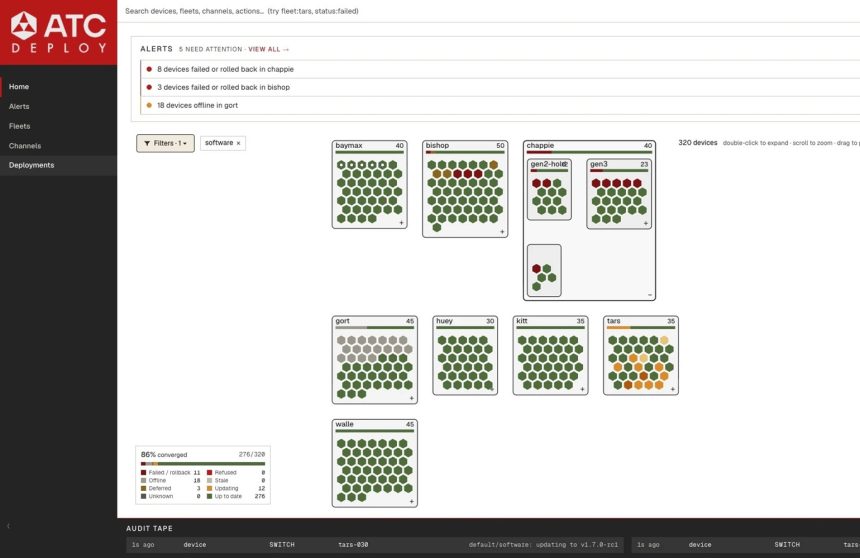
The headline product is ATC Deploy, which pushes software to robots up to 20x faster than a Docker pull. If you’ve ever watched a container image crawl down over a marginal cellular link, you’ll understand why that number matters: faster deploys mean less downtime, quicker rollbacks and more frequent iteration on machines that are expensive to keep idle.
ATC Deploy is described as live today, with three launch partners spanning three demanding sectors:
- Agriculture — robots that operate far from reliable networks and can’t afford to sit still during harvest windows
- Construction — rugged environments where hardware and connectivity are both unpredictable
- Logistics — fleets that need consistent, repeatable updates at scale
Alongside it, the company offers ATC Build, an embedded-compute continuous integration (CI) service. The idea here is to take the misery out of building and testing software for the specific chips robots actually run on. ATC Build supports the Nvidia Jetson lineup, the Raspberry Pi, and other embedded platform targets — the boards that quietly power a huge chunk of today’s autonomous machines.
Why does a dedicated CI service for embedded compute matter? Cross-compiling for a Jetson or a Pi from a developer’s laptop is fiddly and error-prone, and generic cloud CI runners rarely mimic the target hardware faithfully. A service built around those platforms means teams can validate builds against the real architecture before anything ever reaches a robot in the wild.
Taken together, ATC Build and ATC Deploy sketch out a full pipeline: build software against genuine embedded targets, then ship it to a live fleet quickly and safely. It’s a pragmatic pitch, and one that reflects hard lessons from actually operating robots commercially rather than theorizing about them.
Agency Tool Co. hasn’t publicly detailed pricing, and the fine-grained technical specs beyond these features aren’t available yet. But the direction is clear enough: fewer nervous OTA pushes, less waiting on Docker pulls, and a bit more sanity for the engineers keeping robotic fleets running.