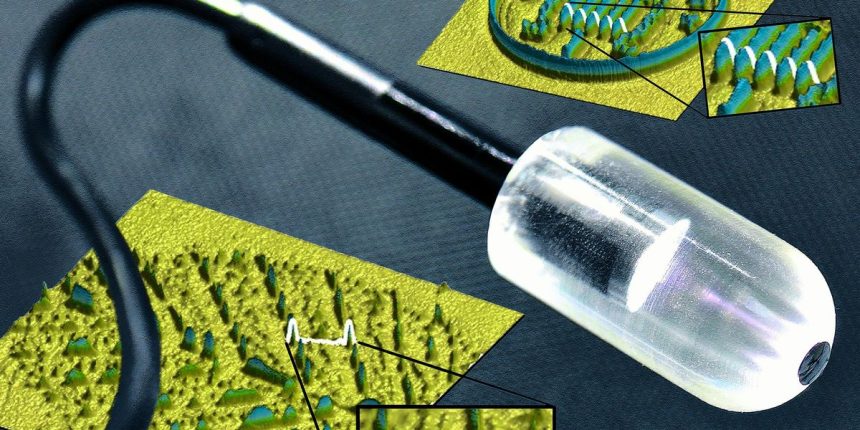
Run your finger over a U.S. penny and you feel Lincoln’s beard, the raised lettering, the fluted columns of the Memorial. Getting a robot to feel the same detail is fiendishly hard — usually you need force and pressure readings gathered across dozens of spatial points at once. A team of European researchers has found a stranger, more elegant route: a robotic fingertip that literally sees touch as color.
Published in Science Advances on July 3, 2026, the work comes from Queen Mary University of London together with the Universities of Florence, Trieste and Trento. Their fingertip is wrapped in a synthetic skin that reflects different wavelengths of light when it deforms. Read that reflected light with a camera, and you can reconstruct topology, strain and contact pressure in real time.
The heart of the trick is a Bragg reflector. Postdoctoral researcher Giacomo Sasso, working in Federico Carpi’s lab, stumbled on a Nature paper describing a mechanochromic material and recreated it in under a week. He exposed a light-sensitive film to a 5-megawatt, 635-nanometer red laser for seven minutes. The laser’s interference pattern polymerizes the film into alternating layers with different refractive indices. Those layers reflect specific wavelengths — and when something presses on them, they stretch, thin out, and reflect a different color entirely.
In the finished finger, that reflector is sandwiched between a protective silicone outer layer and a transparent, fingertip-shaped silicone dome with an embedded LED and camera. Light shines out through the clear polymer; when an object deforms the skin, the reflector bounces color back to the camera. The mapping is intuitive: red for the least deformation, shifting to green and then blue where the skin is pushed hardest.
A few clever tweaks sharpened the results. The outer silicone is dyed black to boost color contrast, and the rigid camera body inside amplifies the reflector’s deformation for bigger wavelength swings. The payoff: 100-micrometer resolution with no computational latency. The team has already mapped a human fingertip, a penny and a leaf.
Why does this matter? Robotic fingertips are cramped, and roboticists still argue over which single sensor type to cram inside. “No one knows yet,” admits Rich Walker of Shadow Robot, who called the approach “distinctly different.” What sets this design apart is that it extracts quantitative depth and size — not just relative feature maps — and it embeds sensing at the material level, with the camera translating what the skin is already doing straight into digital signals.
Skeptics have a fair point. Michael Wang of Daimon Robotics notes that soft materials often struggle with durability, and the real test comes once the finger is fitted to an actual robot hand. Sasso counters that the reflector never touches objects directly, and the silicone barrier can be toughened with chemical coatings.
The group is already in talks with companies and wants the sensor to handle non-flat surfaces — a step that could put it inside surgical tools mapping tissue and organs. This remains lab-stage research, but Carpi sees “a clear path toward transition to real world applications.”