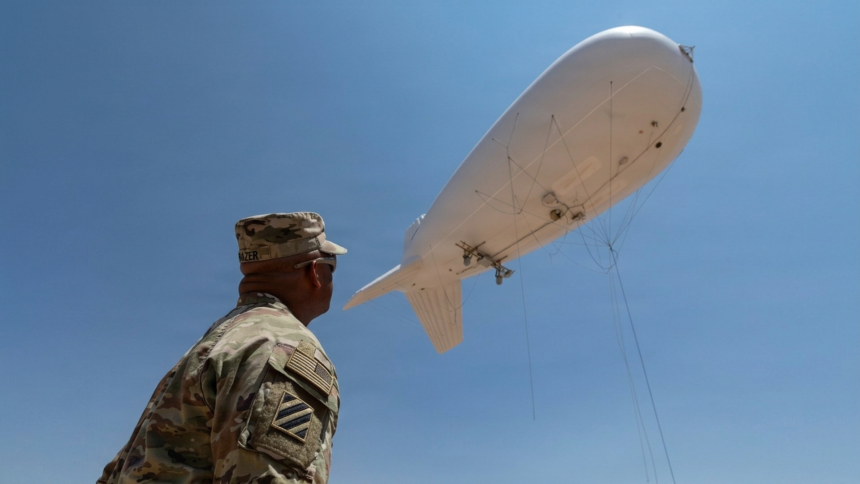
Big, quiet, and hovering thousands of feet overhead — surveillance aerostats are having a strange moment. The US Army has just handed defense contractor TCOM LP a $447 million contract for its Persistent Surveillance Systems-Tethered, or PSS-T, aerostat system. The timing is what makes this interesting: it lands right as cheap battlefield drones are proving how vulnerable slow-moving airborne platforms can be.
If you’ve never seen one, a PSS-T aerostat is essentially a giant tethered balloon carrying a sensor payload. It stays aloft for long stretches, feeding continuous imagery and radar data back down its tether to ground crews. The appeal is endurance — a single aerostat can loiter over an area far longer than any fixed-wing surveillance aircraft, and at a fraction of the fuel and flight-hour cost. That’s the whole pitch behind the word “persistent” in the name.
The new contract isn’t just for hardware. It covers production, fielding, sustainment and lifecycle support — meaning TCOM is on the hook not only to build the systems but to keep them running for years. For a platform like this, sustainment is arguably the bigger line item: aerostats need constant maintenance, tether management, weather monitoring and payload upgrades to stay useful.
Here’s the tension, though. A tethered balloon is, by design, a large and predictable target. It doesn’t dodge. It doesn’t hide. And in an era where a commercial-grade quadcopter costing a few hundred dollars can be weaponized on a battlefield, that predictability is a liability. Analysts have flagged exactly this concern: spending nearly half a billion dollars on slow, static surveillance platforms while adversaries field swarms of low-cost drones raises obvious questions about survivability.
So why is the Army still buying in? Part of the answer is that aerostats and drones don’t really do the same job. A drone is a short-endurance sprinter; an aerostat is a marathon watcher, parked in one spot for days. For border monitoring, base protection and wide-area surveillance well behind the front line, that persistence is genuinely hard to replace. The vulnerability argument bites hardest in contested airspace — and much of the surveillance mission happens far from it.
- Contract value: $447 million
- System: Persistent Surveillance Systems-Tethered (PSS-T) aerostat
- Contractor: TCOM LP
- Scope: production, fielding, sustainment and lifecycle support
The bet, in short, is that the aerostat’s endurance still outweighs its exposure — at least for the missions the Army has in mind. Whether that math holds as drone threats keep getting cheaper and smarter is the question that will follow PSS-T through its entire service life. For now, the balloons are staying up, and the money is committed.