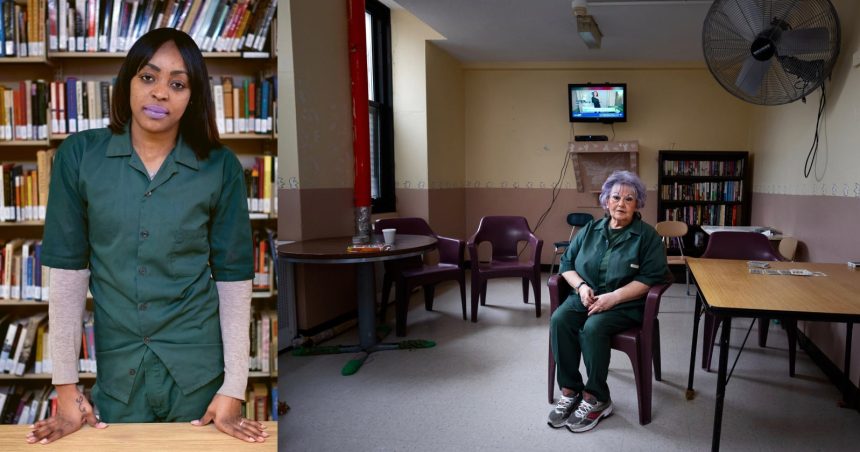
For 13 years, former public defender Sara Bennett pointed her camera at people the American justice system had decided to define by a single moment. The result is Looking Inside: Women with Life Sentences, a new photobook published by Kehrer Verlag that refuses to let those women be reduced to their convictions.
Bennett’s project began in 2009, while she was working pro bono on the clemency case of Judith Clark, sentenced to life at Bedford Hills Correctional Facility for Women for her role in the 1981 Brink’s armored car robbery that killed two police officers and a security guard. Preparing Clark’s application, Bennett photographed 15 women incarcerated alongside her. Those portraits accompanied testimonies detailing Clark’s work behind bars, including advocacy for HIV-positive inmates and programs supporting incarcerated mothers.
What started as legal documentation became something far larger. Bennett eventually left her career as a public defender to focus on photography, writing, and advocacy — and the book that grew out of it traces its subjects across time and space: inside prison walls, in their post-incarceration bedrooms, and back in the outside world after decades away from it.
The images are quietly devastating. Linda, 70, sits in the recreation room for the medically unemployed at Taconic Correctional Facility. Sahiah, 23, incarcerated at 16, is photographed in the college library at Bedford Hills. Judy, 69, appears in the prison nursery. Karen, 69, is shown in a homeless shelter just four weeks after her release, having served 35 years. Veronica, 53, poses with Vernon, her husband of 29 years, 21 months after coming home.
Bennett layers these portraits with personal ephemera — Polaroids, letters, drawings, handwritten notes — building a narrative that resists the flat, one-dimensional stereotype these women are so often flattened into.
Her motivation is explicit. “I began photographing because I was deeply frustrated with the criminal legal system,” she has said. “I believed that if judges, prosecutors, and legislators could see people who have been convicted of serious crimes as individual human beings, they would rethink policies that lock them away forever.”
There’s a real-world coda, too. Clark’s sentence was commuted by then-New York Governor Andrew Cuomo in 2016, and she was released in 2019 after serving 38 years. She now directs the Survivors Justice Project and contributes a powerful afterword to the book.
It’s a project that sits at the intersection of documentary photography and advocacy — proof that a portrait can do more than record a face. Looking Inside: Women with Life Sentences is out now.