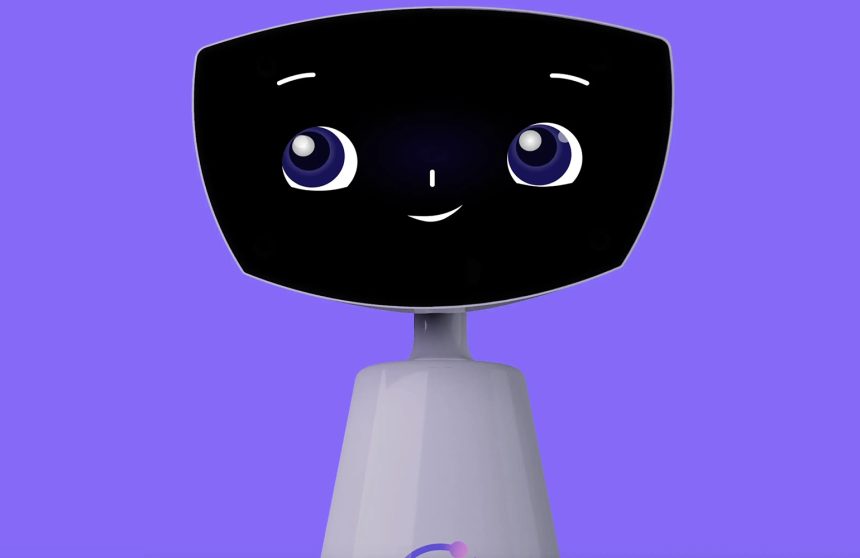
Hospitals are stressful places, especially for children facing needles, scans and unfamiliar equipment. That’s exactly the anxiety Expper Technologies built Robin to defuse — a mobile robot that trades clinical sterility for a friendly, cartoonlike face and a voice designed to sound like a child.
Standing about four feet tall, Robin greets patients with expressive features displayed on a large screen. The child-like presence is deliberate: it puts young patients at ease by meeting them at their level rather than looming over them like another intimidating machine. Instead of adding to the sensory overload of a treatment room, Robin becomes a distraction — a companion to talk to while the harder parts of a visit unfold.
Under the hood, Robin isn’t running fully on its own. The robot operates with roughly 30% autonomy, while the remaining functions are handled by remote operators. That hybrid approach is a smart bet for healthcare, where scripted small talk only goes so far. A human in the loop can read the room, respond to unexpected questions and steer conversations that a purely autonomous system would fumble — all while Robin’s onboard systems handle the routine interactions.
There’s also a practical, hospital-grade side to the design. Robin’s body is made of recyclable bioplastic that can be easily sterilized with ultraviolet light or other disinfectants. In an environment obsessed with infection control, a robot you can’t clean is a robot you can’t use — so Expper engineered Robin to survive repeated decontamination without breaking down.
The company, founded in 2019, has moved well past the pilot stage. As of today, Robin is deployed across 30 different health systems, with plans to roll out to 10 more across additional states. That footprint suggests hospitals are finding real value in a machine whose primary job is emotional rather than mechanical — no diagnoses, no dispensing, just company and calm.
It’s a notable contrast to most healthcare robotics, which tends to chase surgical precision, logistics or lab automation. Robin’s mission is softer but no less measurable: fewer frightened patients, smoother appointments and staff freed from the impossible task of comforting every anxious kid at once.
- Height: about 4 feet tall
- Interface: cartoonlike facial features on a large screen, child-like voice
- Autonomy: about 30%, remainder via remote operators
- Materials: recyclable bioplastic, UV- and disinfectant-safe
- Deployment: 30 health systems, 10 more planned
As robots inch further into the places we least expect them, Robin makes a quiet argument that empathy — or a convincing simulation of it — belongs on the deployment list right alongside speed and accuracy.