Building warships is brutally repetitive, hazardous work — grinding, welding, surface prep across steel hulls the size of city blocks. That’s exactly the sort of job that’s increasingly being handed to machines, and defense heavyweight HII just made one of the biggest bets yet on that idea.
On August 6, 2026, HII signed long-term, performance-based production agreements worth up to US$900 million with two American robotics firms, Path Robotics and GrayMatter Robotics. The deal folds both companies deeper into HII’s HYPER Program, an automation push they had already joined earlier this year.
The through-line here is what the industry likes to call physical AI — robots that don’t just follow a rigidly pre-programmed path, but perceive their surroundings, adapt on the fly, and make decisions about how to tackle a task. That flexibility matters enormously in shipbuilding, where no two components are quite identical and traditional fixed-automation lines simply can’t keep up with the variety.
Both partners bring complementary specialties to the table:
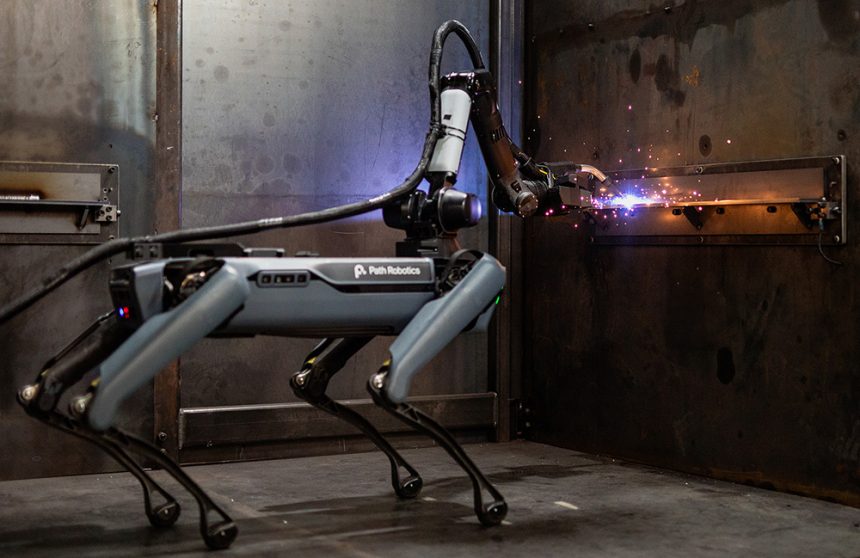
- Path Robotics is best known for autonomous welding systems that can see a part, understand its geometry, and lay down welds without hand-coded instructions for every seam.
- GrayMatter Robotics focuses on AI-driven robots for surface finishing jobs like sanding, grinding and polishing — precisely the tedious, dust-heavy tasks that wear down human workers.
Structuring the arrangement around performance rather than a flat equipment purchase is the interesting wrinkle. Instead of buying a fleet of arms and hoping they pay off, HII is tying the spend to actual output on the shop floor. It’s a model that shifts risk toward the robotics vendors and signals real confidence that the systems can deliver at industrial scale — not just in a demo bay.
The stakes are hard to overstate. U.S. Navy shipbuilding programs have wrestled for years with schedule slips and a shrinking pool of skilled trades workers. Automating the dirtiest, most physically punishing tasks doesn’t just speed up throughput; it lets the remaining human welders and fabricators focus on the high-skill work only they can do, while cutting exposure to fumes, noise and repetitive strain.
At up to US$900 million, this is also a loud vote of confidence for the broader physical-AI sector. For years, general-purpose adaptive robotics lived mostly in pilot projects and glossy conference reels. A commitment of this size, from a contractor whose customers demand ruthless reliability, suggests the technology has crossed from promising to production-ready — at least for the specific, well-defined tasks these two companies have chosen to master.
Whether that translates into faster ships in the water is the question HII is spending nearly a billion dollars to answer.