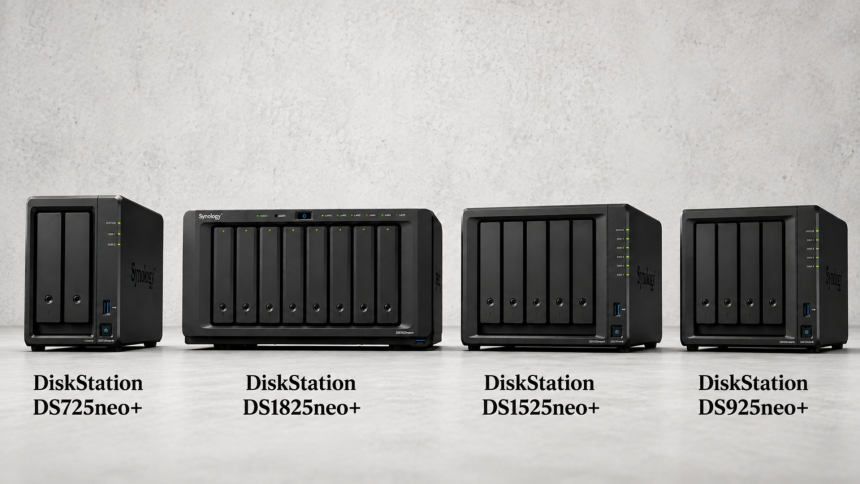
Synology has quietly reshuffled its NAS lineup, and the goal this time is clear: give home users and small businesses more hardware headroom without pushing the entry price into enterprise territory. On August 7, 2026, the company launched the DiskStation neo+ Series, a four-model family that keeps the familiar DSM software intact while opening up the internals for expansion.
The quartet consists of the DS1825neo+, DS1525neo+, DS925neo+ and DS725neo+. Every model ships with 4GB of non-ECC DDR4 SODIMM memory as its default configuration, but that’s just the floor — all four support ECC memory upgrades up to 32GB, which is a meaningful step for anyone running data-integrity-sensitive workloads.
Processing muscle comes courtesy of AMD’s embedded Ryzen line. Three of the four models are built around a 4-core Ryzen V1500B, while the more compact DS725neo+ settles for a 2-core Ryzen R1600. It’s a sensible split: the smaller box doesn’t need to pretend it’s a workhorse, and the rest of the range gets genuine multi-core throughput for concurrent tasks, virtualization and heavier sync duties.
Networking and caching get proper attention too. Each unit includes:
- 2.5GbE network ports for faster-than-gigabit transfers out of the box
- Built-in M.2 slots for SSD caching, so frequently accessed data stays snappy
The two larger models push further. Both the DS1825neo+ and DS1525neo+ carry PCIe 3.0 slots that accept optional 10GbE or 25GbE network cards. That’s the kind of expandability normally reserved for pricier tiers, and it means these boxes can grow alongside a busy office network rather than becoming a bottleneck a year down the line.
Crucially, Synology hasn’t touched the software recipe. The neo+ Series runs the same DSM platform users already know, so there’s no relearning curve — the appeal here is squarely about hardware value and future-proofing, not a reinvented interface.
The neo+ Series is available now through Synology partners and resellers in Hong Kong. Synology has not disclosed exact pricing for Western markets, so the promise of lower entry pricing remains, for now, a positioning claim rather than a number you can pin down. Still, the strategy is easy to read: expandable memory, capable AMD silicon, faster default networking and optional high-speed cards, all wrapped in the DSM ecosystem. For anyone who has watched NAS prices creep upward while wishing for more room to grow, the neo+ line looks like Synology’s attempt to answer both concerns at once.