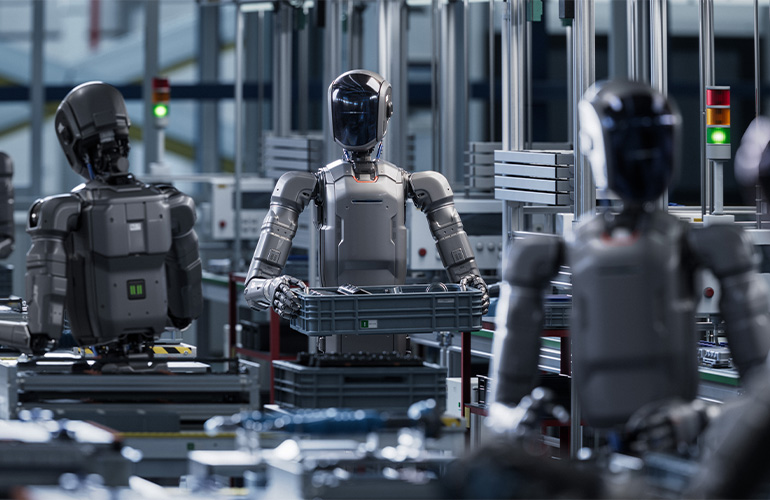
The humanoid robot has stopped being a science-fiction prop and started becoming an engineering problem with a deadline. Across labs and factory floors, machines that walk, grasp and balance on two legs are moving from carefully staged demos toward genuine deployment — and the companies building them are locked in what analysts are increasingly framing as a multi-hundred-billion-dollar race.
The headline number is eye-watering: projections for the humanoid market swing from a few billion dollars today to figures that reach into the trillions over the coming decades, depending on how quickly labor shortages and automation appetite converge. The exact ceiling is anyone’s guess. What’s clear is that the sector is attracting the kind of capital and talent that reshapes industries.
Here’s the twist that too many entrants underestimate: a humanoid isn’t a collection of impressive parts bolted together. It’s a system where every subsystem fights every other one for the same scarce resources — mass, volume, power and heat. Add a stronger actuator and you pay for it in battery drain. Beef up the battery and you pay for it in weight, which the actuators then have to lift. Cram in more compute for perception and planning, and now you’re managing thermals in a chassis that also has to look and move like a person.
This is why integrated design — treating mechanics, power, actuation, sensing and software as one co-optimized whole rather than separate departments — is emerging as the real differentiator. The teams that win won’t necessarily have the flashiest single spec. They’ll have the tightest trade-offs: the best walking gait per watt, the most useful hands per gram, the longest useful runtime per charge.
The field is already crowded with credible contenders. Tesla’s Optimus, Figure’s 02, Boston Dynamics and Unitree are all pushing hardware into the world, each betting on a slightly different balance of dexterity, mobility and cost. The gap between a viral demo video and a robot that earns its keep for eight hours on a warehouse shift, day after day, remains enormous — and that gap is precisely where integrated engineering pays off.
Why it matters for the rest of us:
- Reliability over spectacle — a robot that runs all day beats one that back-flips once for the cameras.
- Efficiency is the moat — power and thermal budgets, not raw torque, will decide which platforms scale.
- Consolidation is coming — a race this large rarely ends with a dozen winners.
For consumers, the payoff is still a few product cycles out. But the design philosophy taking hold now — build the whole machine as one optimized system — is the same discipline that eventually turns a lab prototype into something you might actually meet at work, or one day at home.